Nine thousand lanes, a New Year's Eve buffet, and how not to lose an afternoon to a wrong turn.
VisitedYes — in person
Trip dates27 December 2025 – 3 January 2026
Prices last verifiedSeptember 2026
Sights covered6
The short version
The best view of Fes is free. The hillside south of the medina has no gate, no fee and no closing time — go in daylight or at sunset, not after dark.
The tanneries have no ticket. You go up through a leather shop's terrace and you tip. 20–50 DH a head is right; 100–200 DH is being taken for a ride.
Go to the tanneries mid-morning. The workers are at it from about 09:30 to 14:00 and largely gone by 17:00.
Nobody publishes the madrasa hours or prices. Not the state, not the monuments. Travellers consistently report about 20 DH; treat that as a guide, not a fact.
Bou Inania is a working mosque, so it closes to visitors around prayer times and especially at Friday midday.
Borj Sud & the Merenid Tombs: Hours, Tickets & the Best Time to Visit
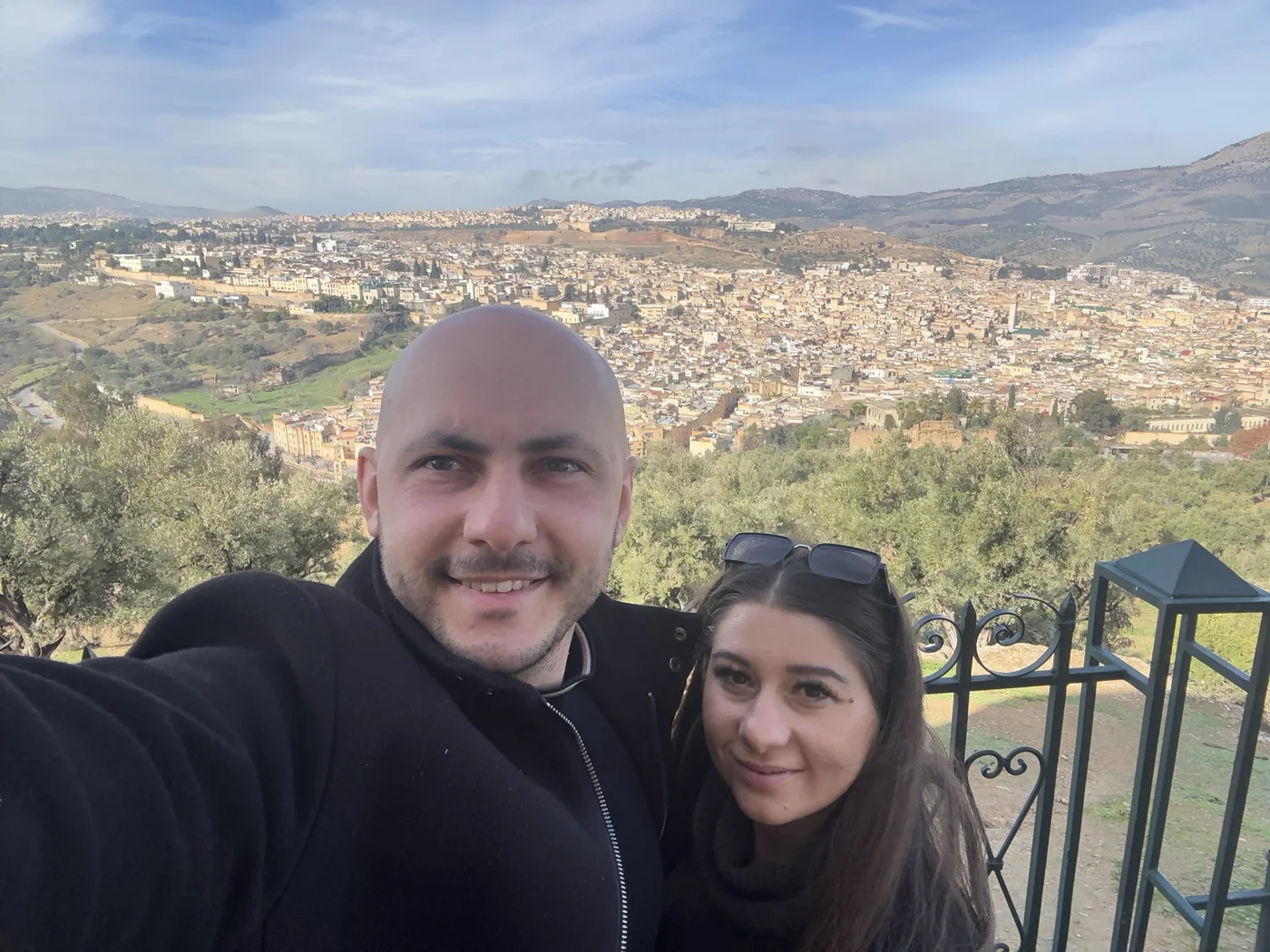
Fes el-Bali sits in a bowl, which means the one thing you cannot do from inside it is see it. Two hills face each other across the valley — the Merenid Tombs to the north, Borj Sud to the south — and from either one the medina resolves from a maze into a single object about a kilometre and a half across, with the green-tiled roof of the Qarawiyyin somewhere in the middle of it.
It is free. No gate, no ticket, no closing time. From Fes el-Bali it is a twenty to thirty minute walk up, or a taxi at roughly 20–30 dirham each way — and if you are going for sunset, it is worth asking the taxi to wait, because the walk down in the dark is not advisable. Pickpocketing and muggings are reported up there after dark.
Opening hoursNo gate, technically 24 hours. In practice: daylight and sunset only.
PriceFree.
Advance bookingNone.
Free entryAlways. (Borj Nord, on the other hill, is a separate ticketed arms museum — we could not verify its fee.)
Best timeLate afternoon into sunset, with the light coming across the medina rather than into your lens. Ours is at 13:51 and the light is flat by comparison.
AllowAn hour including the walk up.
We wentFree entryOfficial source — None — there is no official page for either viewpoint.
We Took a Guided Tour of the Medina — and We Would Do It Again
Fes el-Bali has around nine thousand lanes and no logic you can learn in a day. It is the largest car-free urban area in the world, the streets are unsigned and unmapped in any way your phone can follow, and the two or three times we tried to navigate it ourselves we came out somewhere we had not aimed for. So we took a guided tour, and it is the thing we would tell anyone to do on their first day here.
A guide is not about facts you could have read. It is about the doors that are not obviously doors. A medina lane is a wall with openings in it, and behind the openings are a fourteenth-century madrasa, a working tannery, a bakery where the neighbourhood brings its own dough, a weaver, a herbalist. On your own you walk past all of it. With someone who knows the quarter, the day opens up — and when the lane forks six ways you keep walking instead of standing there with a phone.
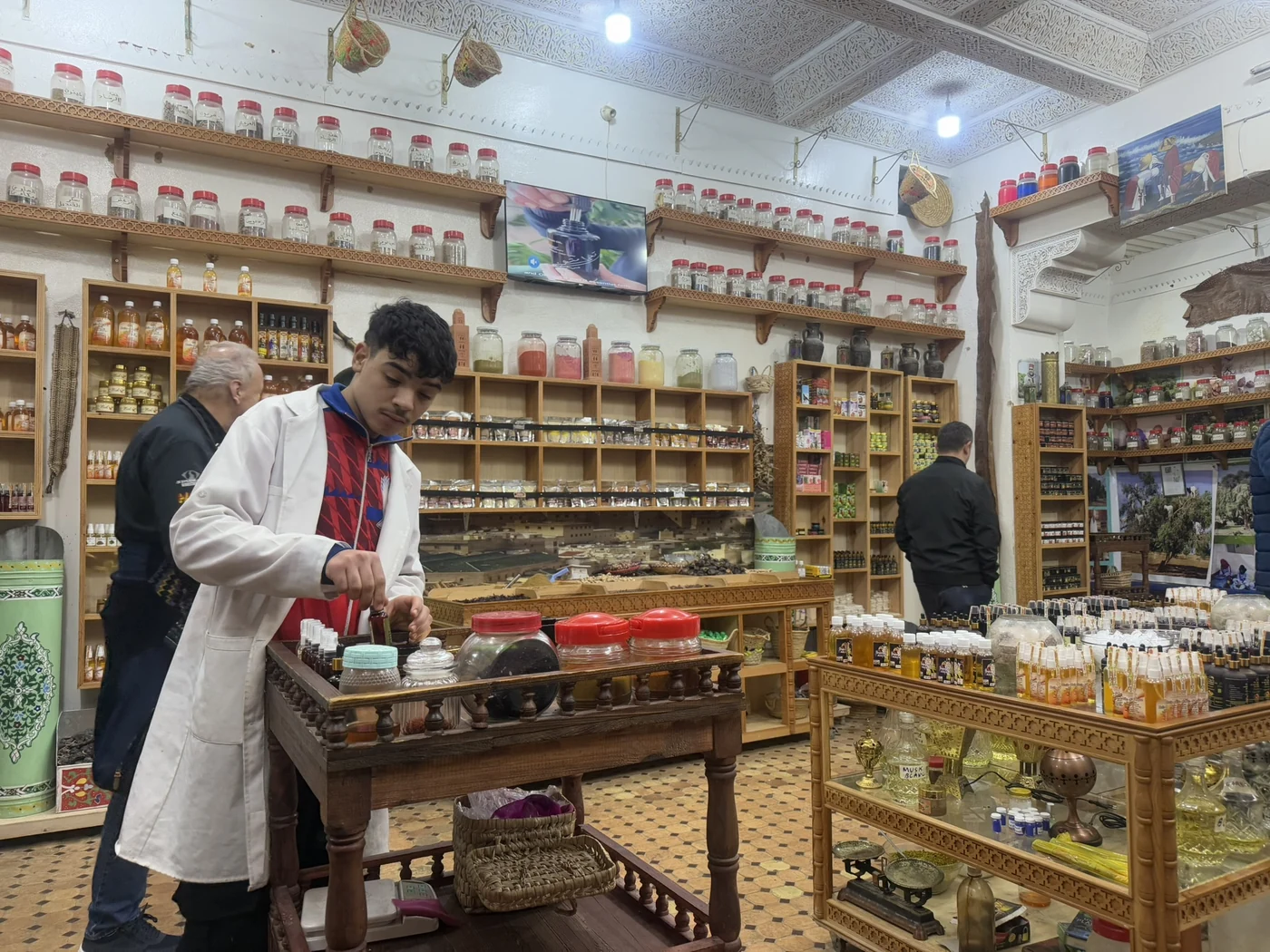
The herbalist's shop — argan, saffron, nigella, the whole demonstration. Interesting, and a sales stop. Both at once. 1 Jan · 11:53
Be honest with yourself about the shopping
Every guided medina tour includes stops where things are sold to you. A herbalist, a carpet co-operative, a leather shop above the tanneries, sometimes a weaver. The demonstrations are real and often genuinely good; the guide is also being paid a commission on whatever you buy. Those two facts sit together and neither cancels the other.
The way to handle it is simple and nobody will be offended: say at the start how much shopping you want. We said we wanted to see the medina rather than the shops, and the stops were kept short. Drink the tea, ask questions, buy if you want to, and do not feel pushed into a carpet because you were given a glass of mint tea.
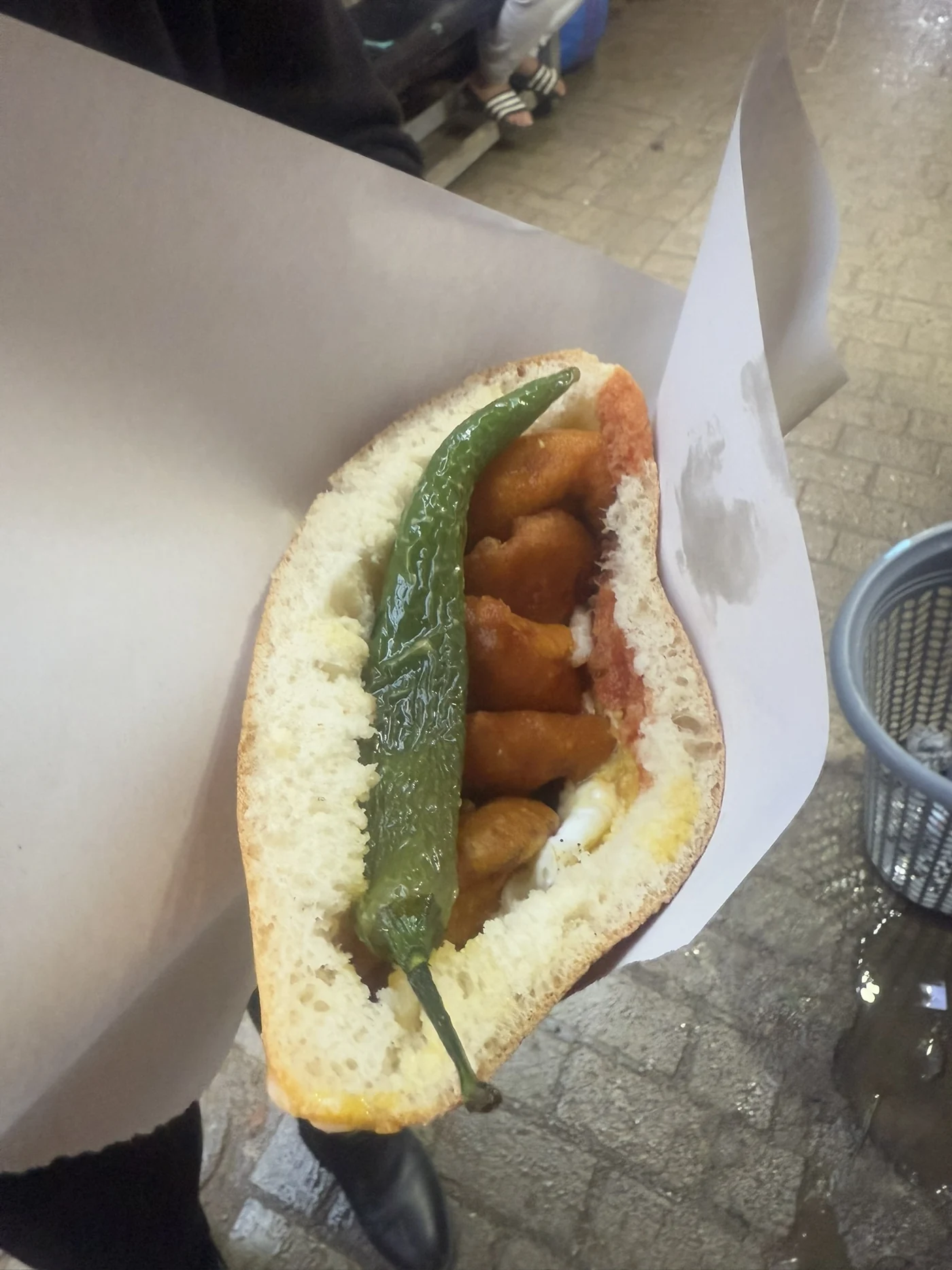
Lunch afterwards, for small change: fried potato in bread with a whole green chilli in it. 1 Jan · 14:41
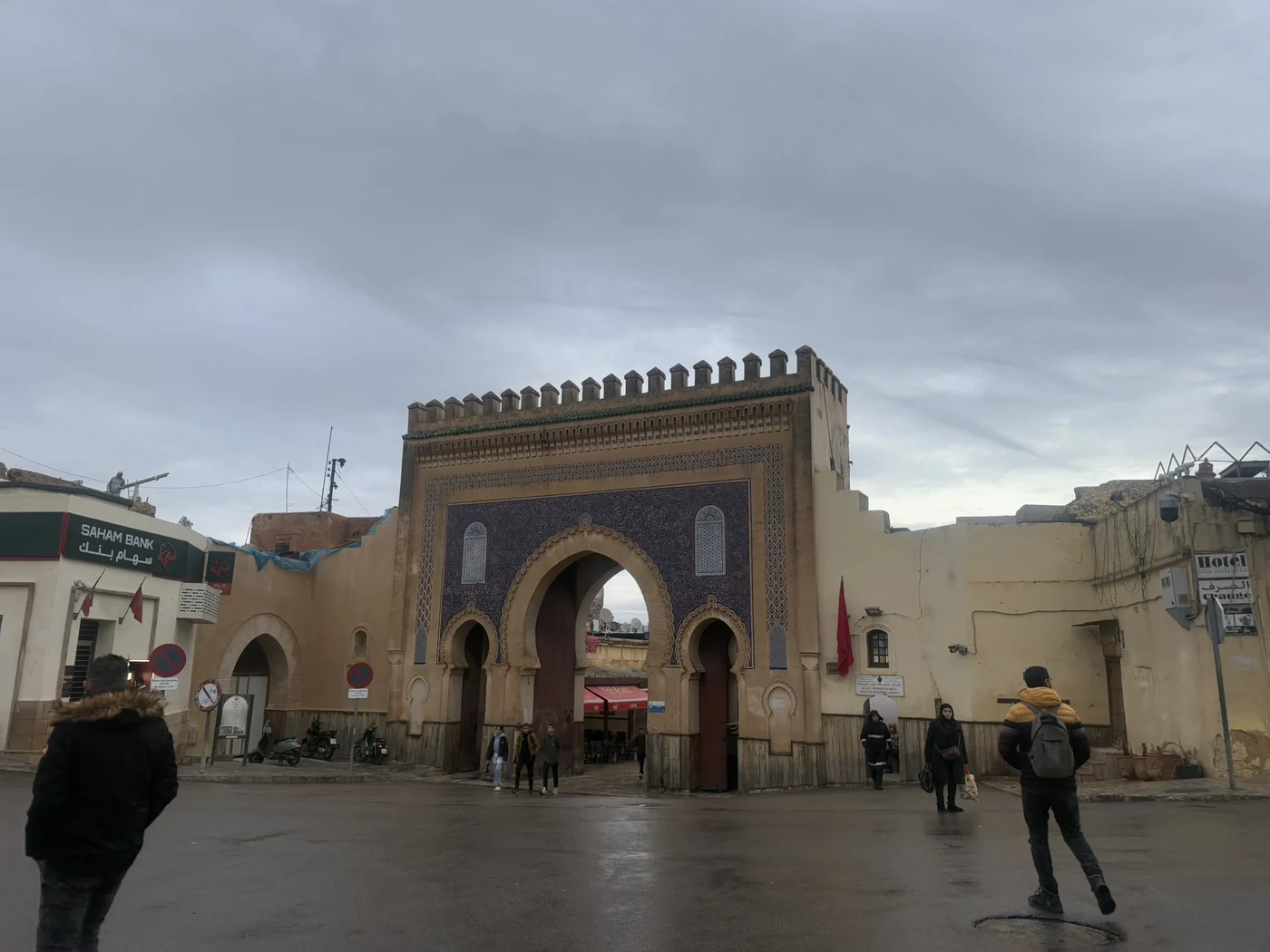
Where to start:Bab Bou Jeloud, the blue gate at the top of the medina, is where nearly every tour begins and the one landmark everybody can find. Blue tiles on the outside face, green on the inside — blue for Fes, green for Islam — and two of the medina's main streets run downhill from it.
Do you need one?On your first day in Fes el-Bali, yes. This is the one medina in Morocco where we would say that without hedging.
PriceGuides are arranged through riads and agencies and the rate is negotiated, not posted. Agree the figure, the length and the number of shopping stops before you set off.
AllowHalf a day. Ours ran from late morning into the early afternoon.
Best timeMorning, while the workshops are working. The tanneries need sun on them, so late morning is the sweet spot for both.
Where it startsBab Bou Jeloud, the blue gate, at the top of Fes el-Bali.
We wentOur own guided tour, 1 January 2026.
The Chouara Tanneries: How Access Really Works & What to Tip
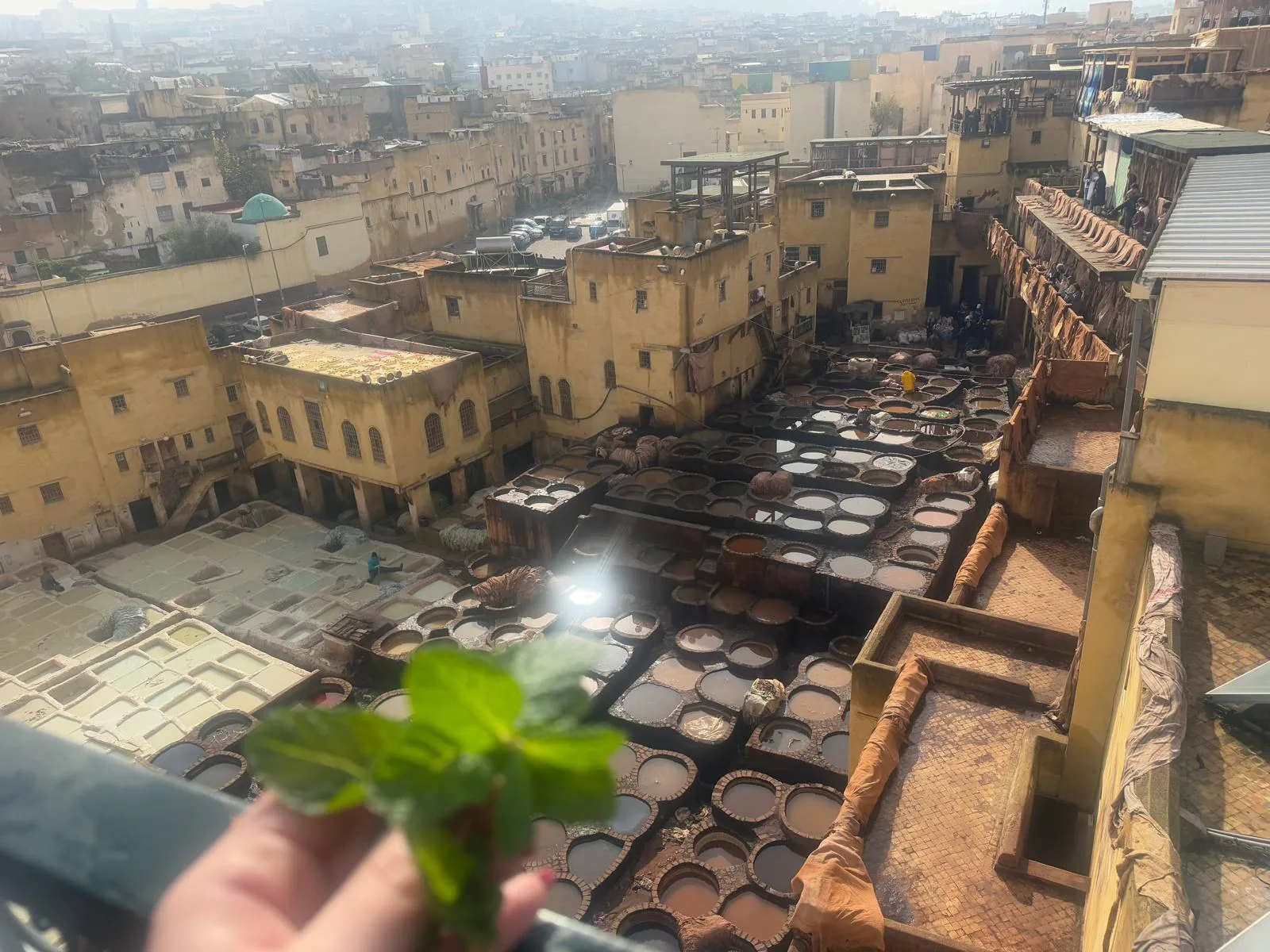
This is the most photographed thing in Morocco and there is no ticket, no official viewpoint and no published anything. The tanneries are surrounded by leather shops, and the shops' upper terraces are the viewpoint. You walk in, someone hands you a sprig of mint for the smell, you are taken upstairs, you look at the pits, and on the way down you are shown the leather. Shop No. 10 on Derb Chouara and Shop No. 64 are the two most commonly used.
What to pay. There is no entry fee — but a tip is expected and you should give one. 20 to 50 dirham per person (roughly €2–4.50) is the going rate. If you are quoted 100 or 200, that is an opening position and not the price. You are not obliged to buy leather, and saying so pleasantly at the bottom of the stairs is easier than at the top.
When to go. The men are in the pits from about 09:30 to 14:00, thin out through the afternoon and are largely gone by 17:00, and Friday around prayers is quiet. Late morning is the compromise between the light being good and the smell being bearable.
Check before you build a day around it. The pits are periodically drained for renovation, and a drained tannery is a set of empty concrete holes. We could not confirm their state for 2026 either way. If it matters to you, ask your riad the evening before.
That is how the visit actually begins. Someone meets you at street level, the mint comes out, and you climb two or three flights of a leather shop to come out above the pits. Nobody asks for anything on the way up.
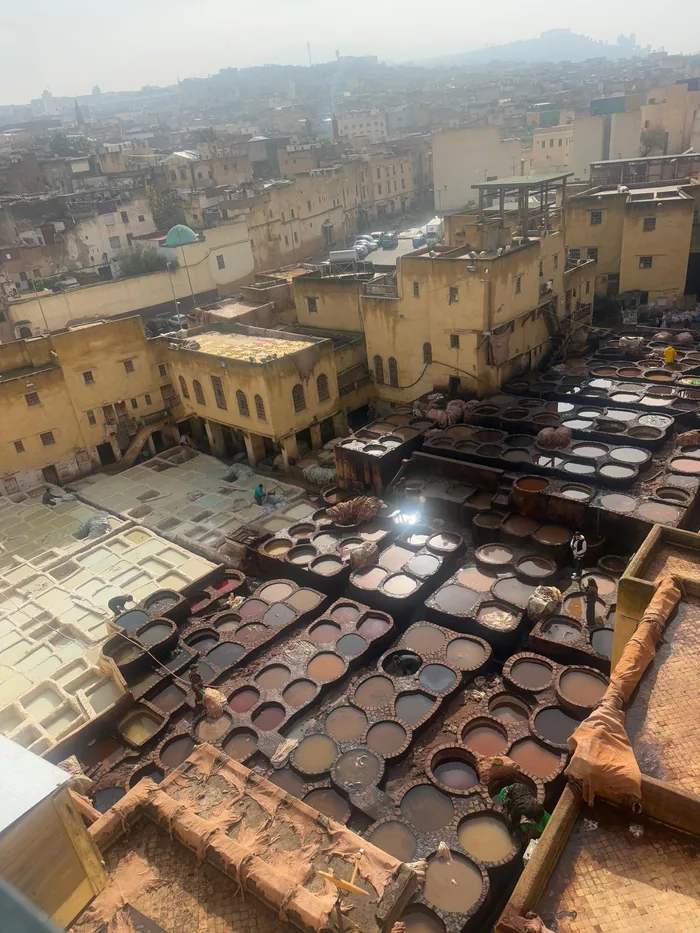
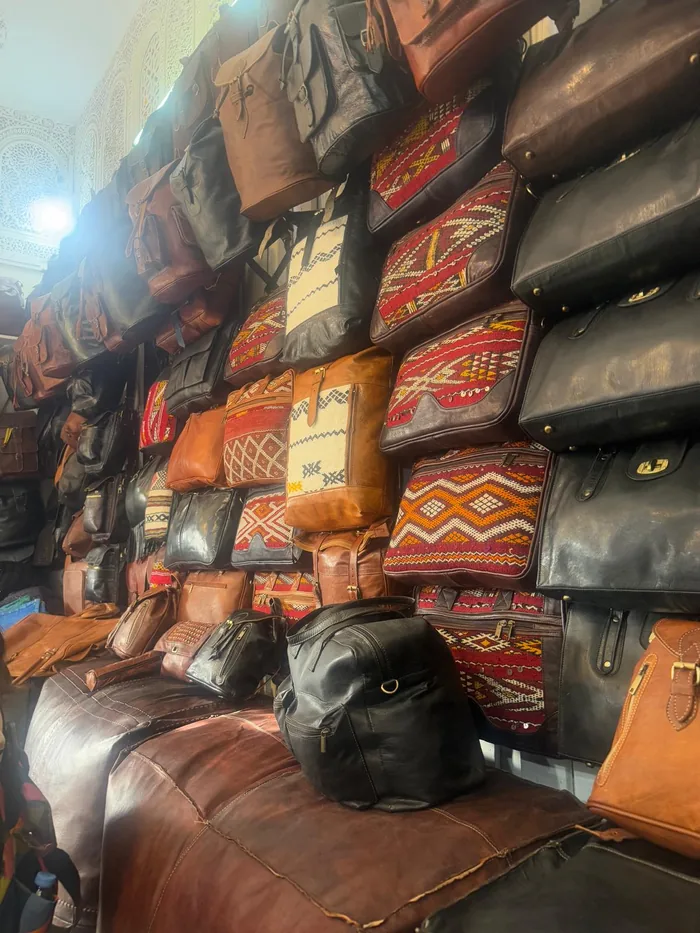
The white pits at the left are lime and pigeon droppings, where the hides are stripped. The coloured ones further in are the dyes.And this is the room you come down into. The kilim-panelled bags are the ones worth looking at.
The shop is not optional in the sense that you will pass through it, but it is optional in the sense that nothing happens if you leave without buying. We did not get a price list, and the only honest thing to say about what things cost in there is that the first number is never the last one.
Access, tipping norms and working hours from this detailed first-hand account, updated January 2026. No official source for any of it exists.
Bou Inania & Al-Attarine: What Is Actually Known About the Fes Madrasas
Two fourteenth-century Quranic schools, a few minutes apart, both covered in carved cedar, stucco and zellij, and both almost completely undocumented. Neither has an official website. Neither is on Morocco's Ministry of Culture ticketing portal. No opening hours are published anywhere, by anybody, and there is no booking system to use.
On price, visitors in 2024 and 2025 consistently report about 20 dirham (roughly €1.85) at each. We are repeating that because it is the only number there is, and flagging that it is traveller-reported rather than official. Take cash and small notes.
The one hard constraint: Bou Inania is still a working mosque, which is unusual for a madrasa, so visits are only possible outside services. Friday midday is out. A weekday morning is the safe answer. The famous water clock on the wall across the street was under repair as of early 2026.
Did you get into either madrasa? If so, what did you pay and when did you go — a real 2026 price from you would be the only one on the internet that is not second-hand.
Opening hoursUnpublished. Bou Inania closes to visitors around prayer times and at Friday midday. Weekday mornings are the reliable window.
PriceAbout 20 DH each, traveller-reported. No official tariff exists.
Advance bookingNo system exists. Cash at the door.
Free entryNone found.
Best timeLate morning, when the sun reaches down into the courtyards.
Allow30–40 minutes each.
Official source — None exists for either monument.
The Royal Palace Gates: What You Can Actually See (and What You Cannot)
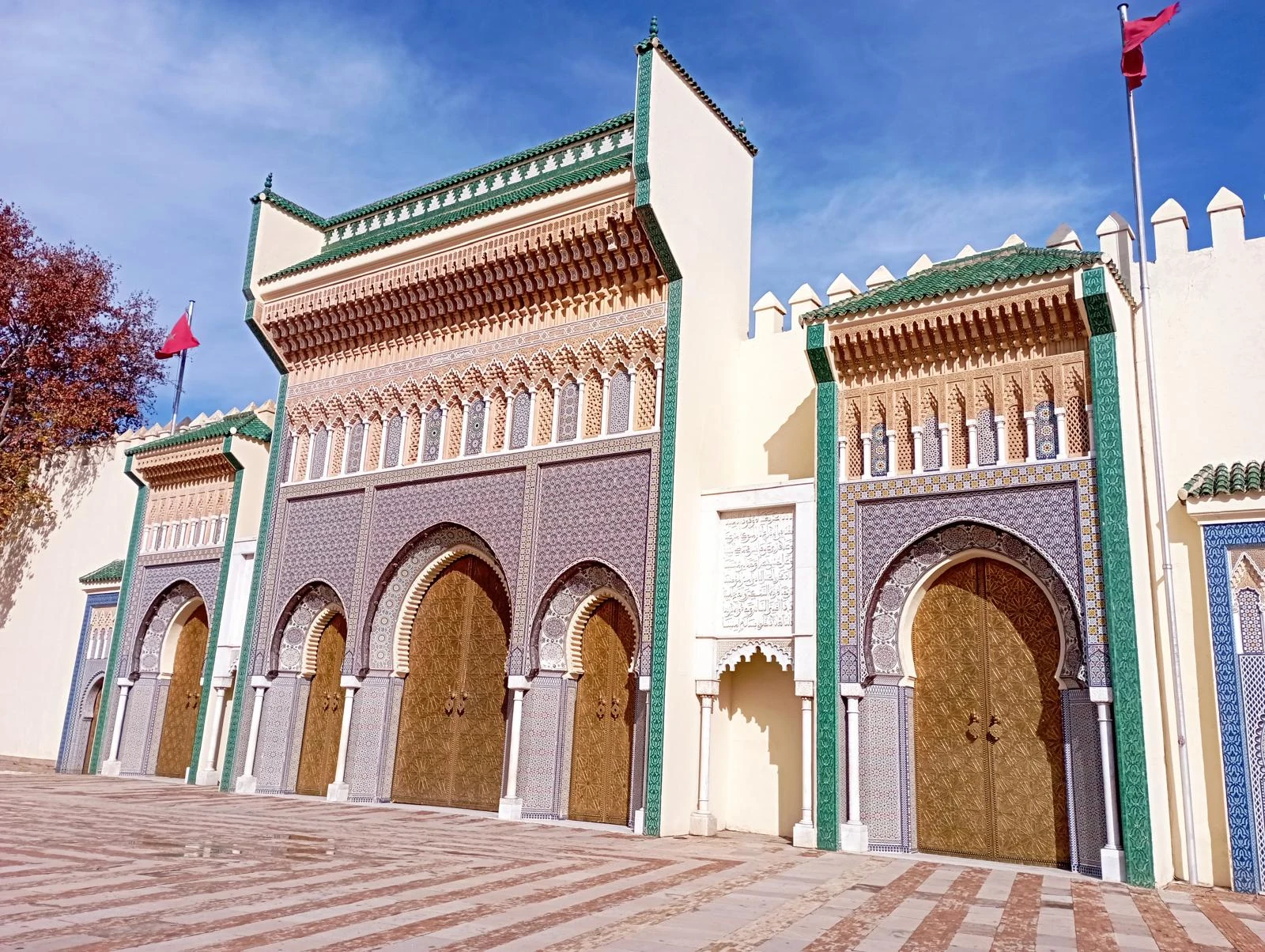
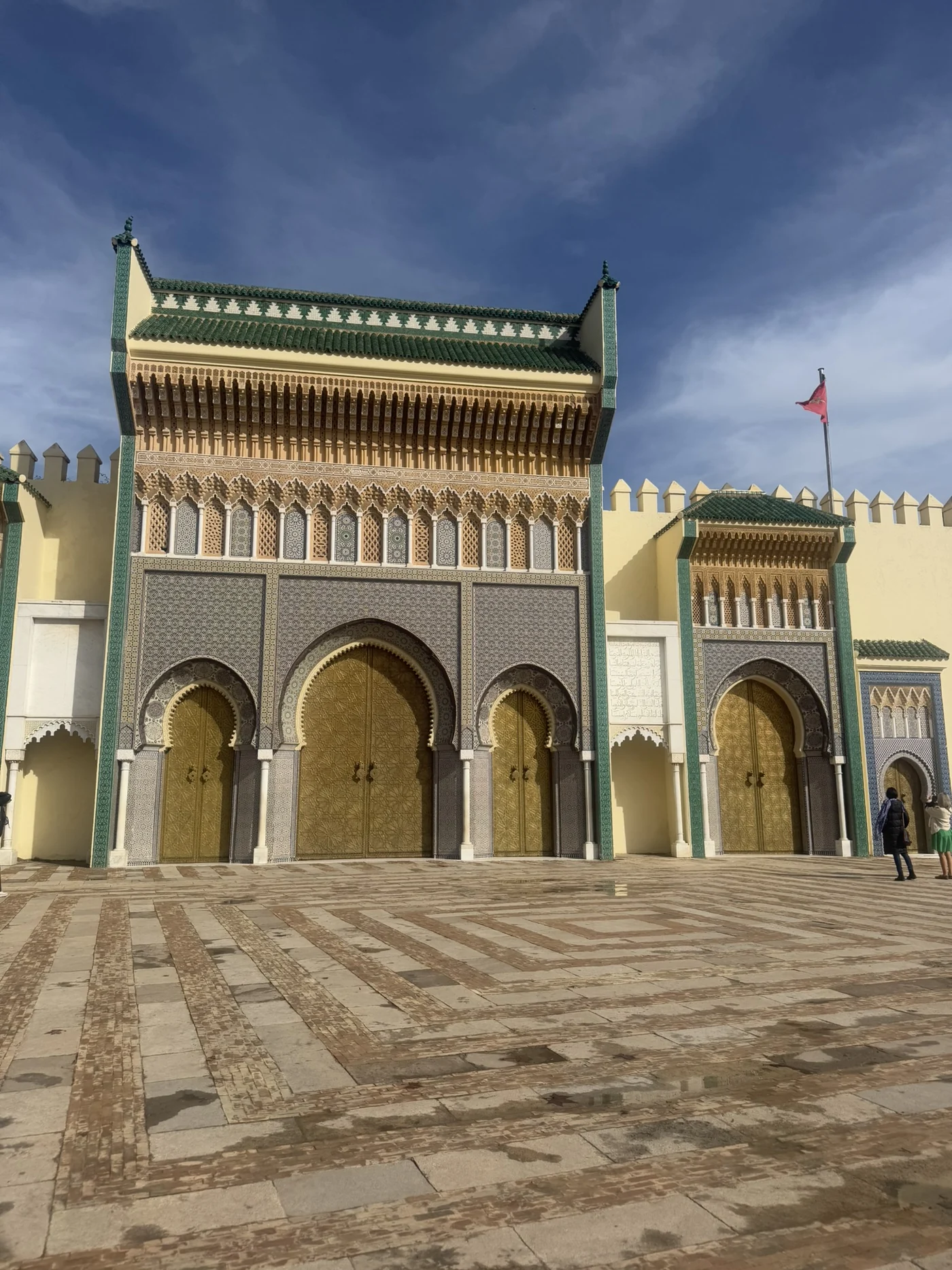
The golden doors on Place des Alaouites are the most photographed thing in Fes after the tanneries, and the most misunderstood. This is a working royal residence and the interior is closed to the public. There is no ticket, no queue and no tour. What you come for is a square and a wall, and that wall happens to be one of the finest pieces of craftsmanship in the country. We stood in front of it at 13:16 on New Year's Day with the whole square to ourselves.
What you are looking at is a row of horseshoe arches set into a plain ochre wall: doors of engraved, gilded bronze, framed in bands of zellij mosaic tile, under eaves of carved cedar and green glazed roof tiles, with honeycombed muqarnas niches above. Stand close enough and the geometry resolves into thousands of individually cut tile pieces; step back and the whole thing reads as one surface.
The thing almost nobody mentions
These gates are not ancient. The palace itself goes back to 1276, when the Marinid sultans founded Fes el-Jdid as a fortified royal city, and most of what stands behind the wall is seventeenth-century or later. But the square was laid out in the 1960s and these doors were made between 1969 and 1971 — modern work, by living craftsmen, in techniques a thousand years old. That is not a disappointment. It is the point: the trades that built medieval Fes were still good enough, fifty years ago, to produce this.
Where it sits, and what to do with the walk
The square is in Fes el-Jdid, the royal quarter, which is a different place from the old medina most visitors spend their time in — newer, straighter, far quieter. Directly beside it is the Mellah, the old Jewish quarter, with its distinctive wooden balconies overhanging the street. Do not make a special trip for the gates alone; fifteen minutes is all they take. Pair them with the Mellah and you have a decent half-morning away from the crush of Fes el-Bali.
Can you go in?No. The palace is a working royal residence and is closed to the public. The gates are the visit.
Opening hoursAn open public square — any time. The brass takes direct sun for part of the day and goes flat in shade.
PriceFree.
Advance bookingNone. There is nothing to book.
Allow15 minutes for the gates. Half a morning if you add the Mellah next door.
Getting thereFes el-Jdid, about 15–20 minutes on foot from Bab Bou Jeloud, or a short taxi from the medina.
We wentFree entryExterior only — dates and construction checked against the published record of the palace.
New Year's Eve in Fes
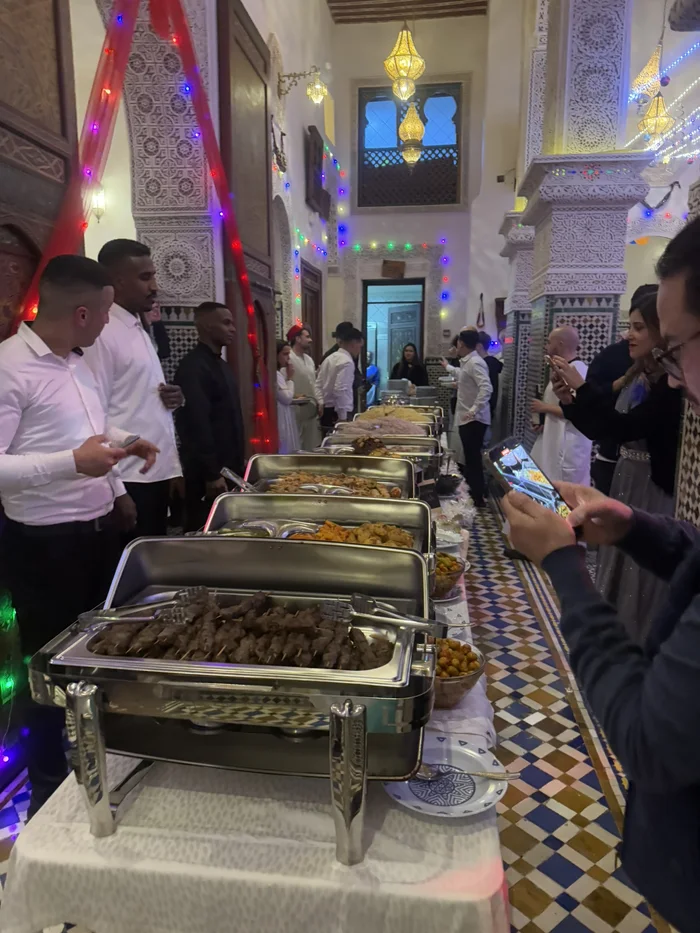
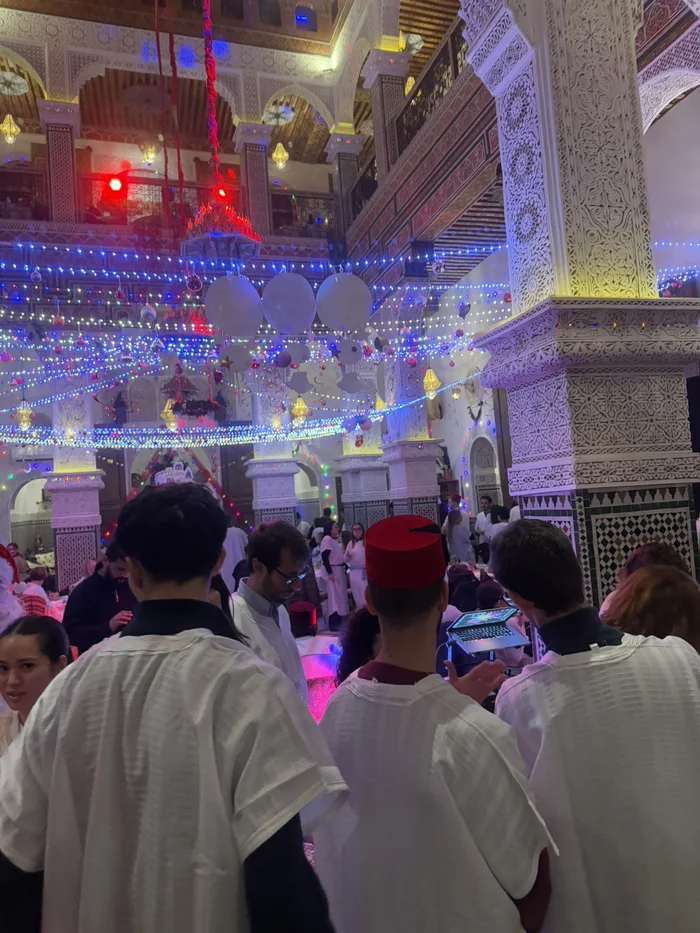
We came back from Chefchaouen in the evening and spent New Year's Eve where we were staying — Riad Tayba(affiliate link), inside the medina — a courtyard under coloured light, a long buffet down one side of it, and staff in white jellabas. It ran past two in the morning.
What the room cost. Two nights, 30 December to 1 January, €116 in total — €58 a night for two over New Year, in the old city. That is the single best-value bed of the whole trip, and it is worth saying out loud, because the equivalent night in Marrakech or anywhere in southern Spain on 31 December is two to three times it. Fes is the cheap place to be on New Year's Eve.
The courtyard filling up. 22:13
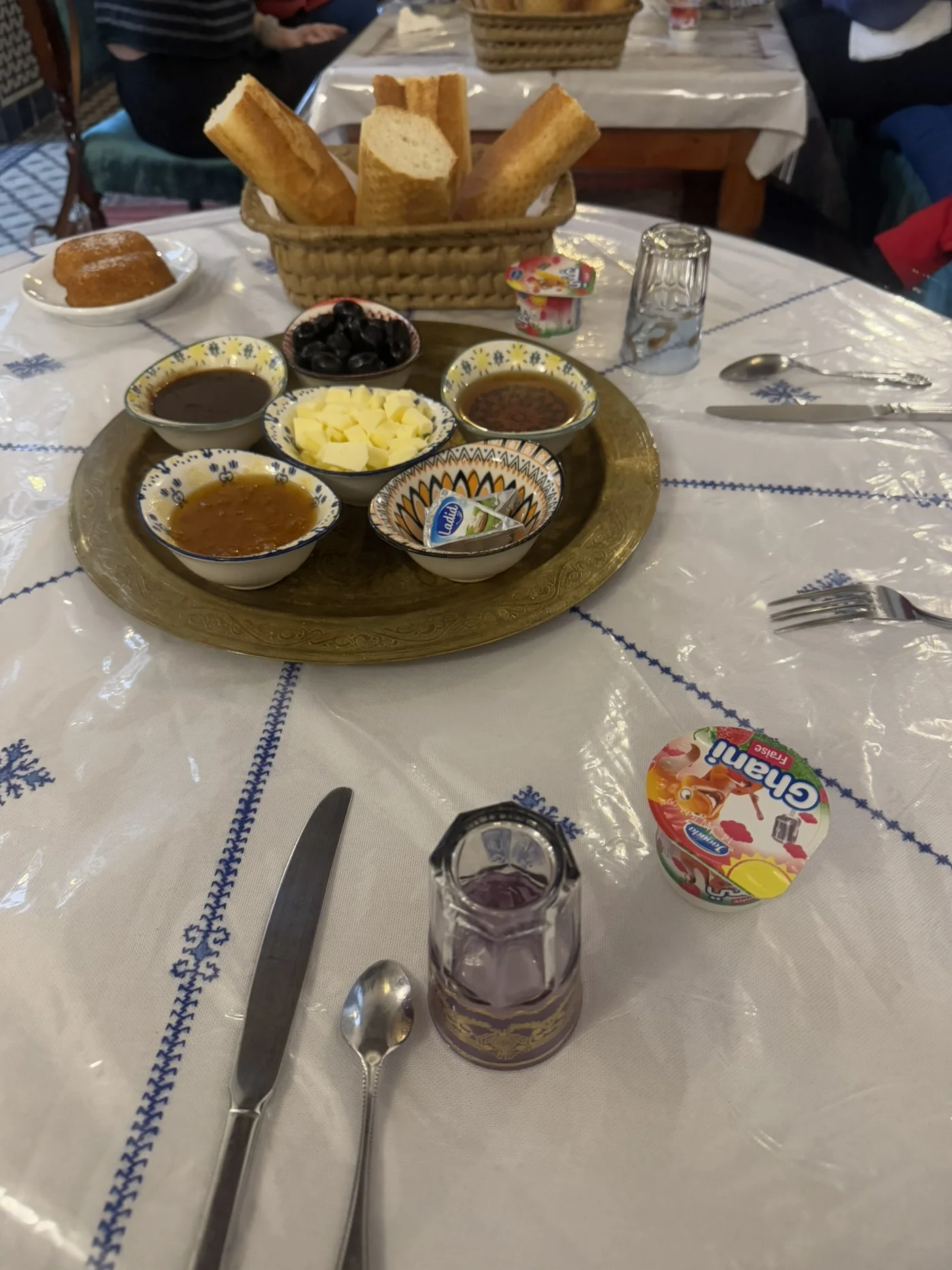
Still going at twenty past two. 02:20Breakfast on the first of January, which was a slower affair. 09:04
What the dinner cost.€100 a head, on top of the room. Hold those two numbers next to each other for a second: the bed was €58 a night for two, and the dinner was €200 for two. The New Year's Eve dinner cost more than the entire two-night stay, and it is by a distance the most expensive single thing we did in Morocco.
Was it worth it? For what it is — a full buffet, a courtyard done out in light, live music, and the thing running until two in the morning without anyone looking at a clock — yes, on the night. But it is worth saying plainly, because almost nobody writes this down: riads in Fes price New Year's Eve as a separate event, not as dinner. You are booking a party, and the room rate tells you nothing at all about what the evening will cost. Ask the number before you book the dates, not after.
We went
Quick answers
Fes FAQ
How much should you tip at the Fes tanneries?
Twenty to fifty dirham a person, roughly two to four and a half euros. There is no entry fee — you are taken up through a leather shop's terrace — but a tip is expected. Quotes of 100 or 200 dirham are an opening position, not a price.
What time should you visit the Chouara tanneries?
Mid to late morning. The workers are in the pits from about 09:30 until 14:00, thin out through the afternoon and are largely gone by 17:00. Friday around prayer time is quiet. Around 09:45 gives you activity, decent light and the mildest version of the smell.
Is the viewpoint over the Fes medina free?
Yes. Both the Merenid Tombs to the north and Borj Sud to the south are open hillsides with no gate and no fee. It is a twenty to thirty minute walk up from the medina, or 20 to 30 dirham in a taxi. Go in daylight or at sunset — not after dark.
How much do the Fes madrasas cost?
Visitors report about 20 dirham each for Bou Inania and Al-Attarine, which is roughly two euros. There is no official tariff and no published opening hours for either — neither monument has a website or appears on the government ticketing portal.
Can you visit Bou Inania Madrasa on a Friday?
Not around midday. Bou Inania is still a working mosque, so it closes to visitors during services and Friday midday prayers in particular. A weekday morning is the reliable time to go.
A little more adventure in your inbox.
The newsletter is being set up. Until it opens, write to us and we'll add you to the first send — and we'll answer any question about a trip while we're at it.