Roads of Adventure
HomeDestinationsTravel MapTravel SmartOur Story
Morocco3 daysGuide

3-Day Sahara Desert Tour: Marrakech to Fes via Merzouga

Three days, one night in the dunes, and the parts of the tour nobody tells you about in advance.

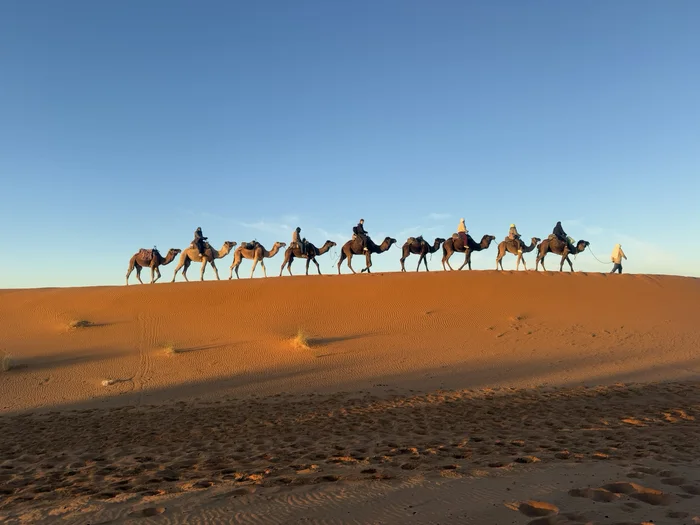
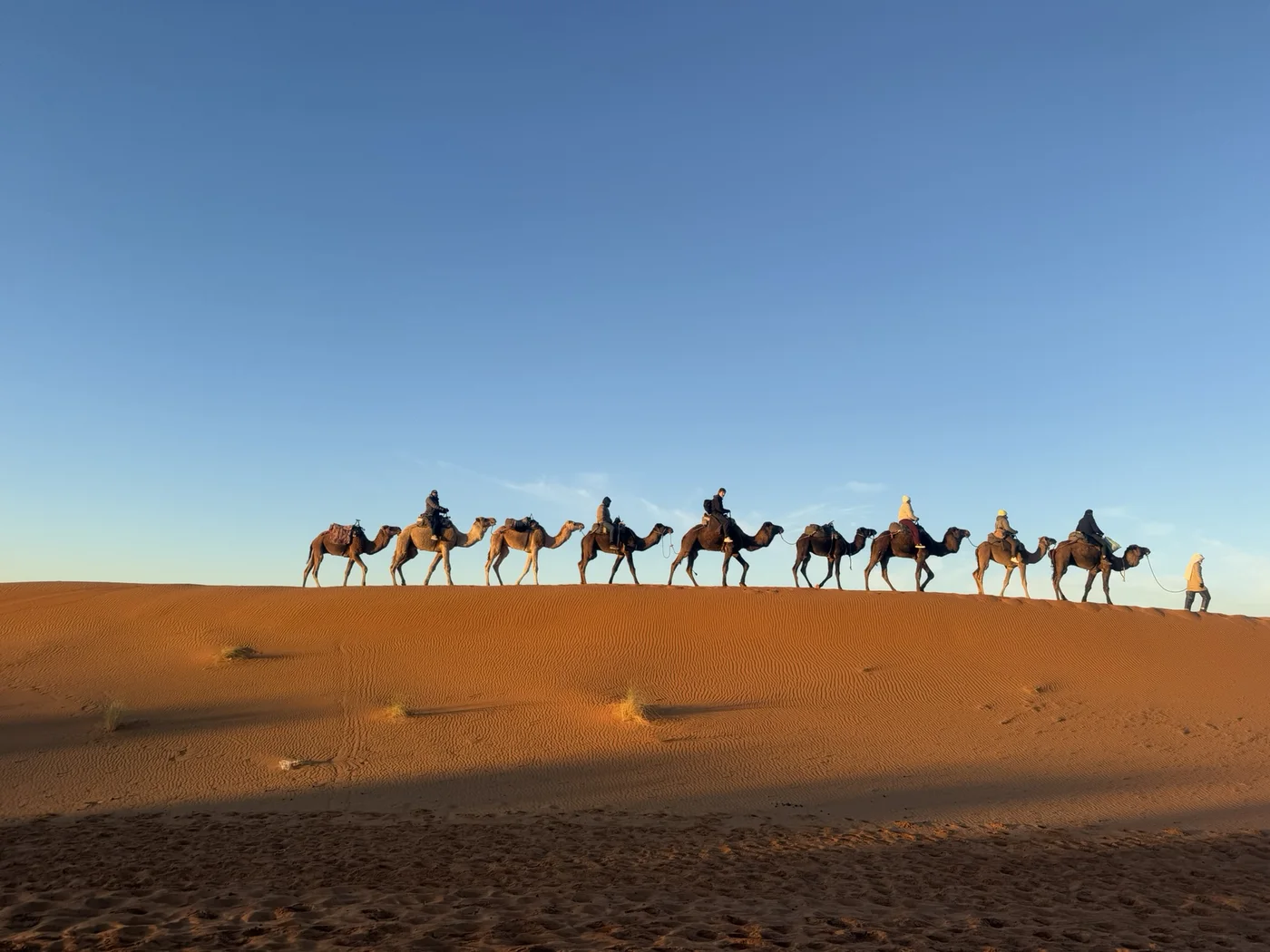
A camel caravan crossing the crest of a dune at Erg Chebbi in the Moroccan Sahara.
VisitedYes — in person
Trip dates27 December 2025 – 3 January 2026
Prices last verifiedSeptember 2026
Sights covered6

The short version

  • It is one-way, and that is the point. The tour starts in Marrakech and ends in Fes, so you cross the country instead of backtracking.
  • Roughly €95–€200 per person, shared minibus at the bottom, private car at the top.
  • Lunches, drinks and your Fes hotel are not included. Neither is quad biking, at about €50 a quad.
  • Day two is the long one — Todgha Gorge in the morning, on the camels by late afternoon.
  • Sunrise is the reason you came. In late December the sun broke the dune crest a little after 08:15, and the caravan set off half an hour later.
  • It is genuinely cold at night in the dunes in winter. Take more than you think.

The 3-Day Marrakech to Fes Desert Tour: What You Get for the Money (2026)

This is a private tourism market, not a state monument, so there is no official tariff to quote — only what the operators publish. What follows is the shape of the tour as advertised consistently across the two largest booking platforms in September 2026, and it matched our own three days.

DayRouteNight
1Marrakech from about 07:00 · Tizi n'Tichka pass over the High Atlas · Aït Benhaddou with a local guide · the Road of a Thousand KasbahsHotel, Kalaat M'Gouna or Tinghir · dinner included
2Todgha Gorge and the Tinghir oasis · on to Erg Chebbi · camel trek into the dunes at sunset · sandboardingDesert camp · dinner and drumming included
3Sunrise camel trek out · the Ziz valley · the Middle Atlas cedar forest and its macaques · Ifrane · Fes by about 19:00Not included — book your own bed in Fes

Included, and not

Normally included: an air-conditioned vehicle with a driver-guide, hotel pickup and drop-off, one hotel night and one camp night, two breakfasts, two dinners, both camel treks, sandboarding, and a local guide at Aït Benhaddou.

Normally excluded, and worth budgeting for: every lunch and all drinks (reckon on €10–13 a meal), your hotel in Fes on the third night, quad biking at about €50 a quad, and optional local guides at a couple of euros a head.

Structure and prices as listed on GetYourGuide and Viator, checked September 2026. These are operator listings, not an official tariff.

What we actually paid

We booked the Marrakech–to–Fes crossing through GetYourGuide for €395.86 for two people — €197.93 each — for departure on 28 December 2025. That is the whole three days: the vehicle and driver-guide, the two nights, the two dinners, both camel treks and the guide at Aït Benhaddou. Lunches, drinks and the bed in Fes on the third night were ours to pay, as above.

Two things worth knowing before you compare that number to anything else. It is a shared tour, not a private one — private crossings run at roughly double. And it is a late-December price in the week between Christmas and New Year, which is high season for this particular route, so it is a ceiling rather than a bargain. The same listing is quoted lower outside the holidays.

See the tour listing
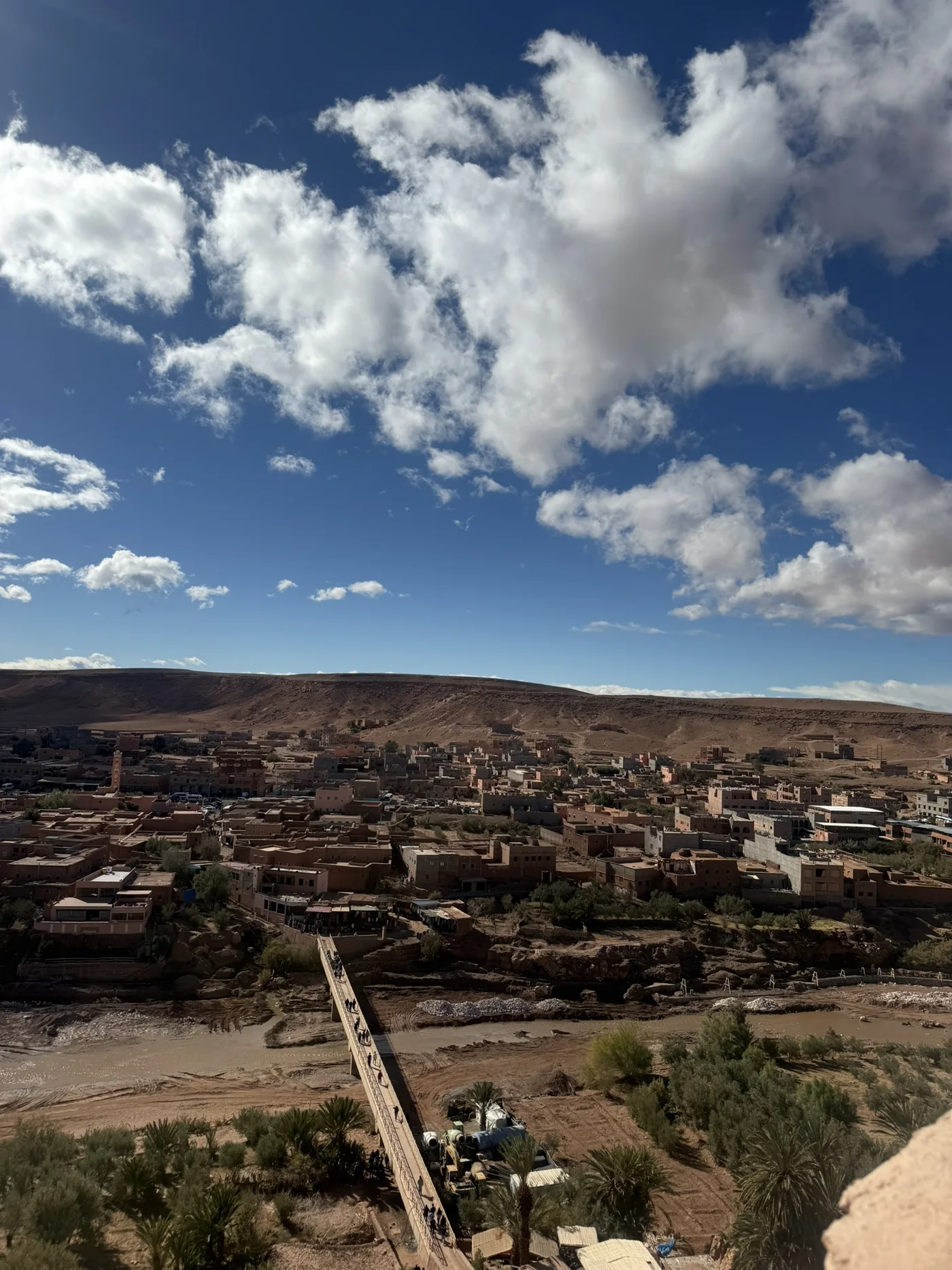
The valley at Ait Benhaddou seen from above, with the village, the palm oasis and the dry riverbed below a bright cloudy sky.

Aït Benhaddou: Access, Fees & the Best Time to Visit (2026)

A fortified earthen village on the old caravan route between the Sahara and Marrakech, on the UNESCO World Heritage list since 1987. Almost everyone who lived in it has moved across the river to the new village, and UNESCO itself flags the consequence: the earthen buildings are “very vulnerable due to lack of maintenance and regular repair resulting from the abandonment of the ksar by its inhabitants.”

There is no ticket office and no state entry fee — it is an inhabited site and it is not on the Ministry of Culture's ticketing portal at all. What there is instead is a patchwork: individual kasbah houses and the climb to the granary at the top charge small amounts, in cash, set by whoever is standing there. Budget loose dirham and expect to be asked more than once.

The river. You cross the Ounila on foot, on stepping stones, and in normal conditions that is all there is to it. After rain the water comes up; there is a small bridge upstream for that.

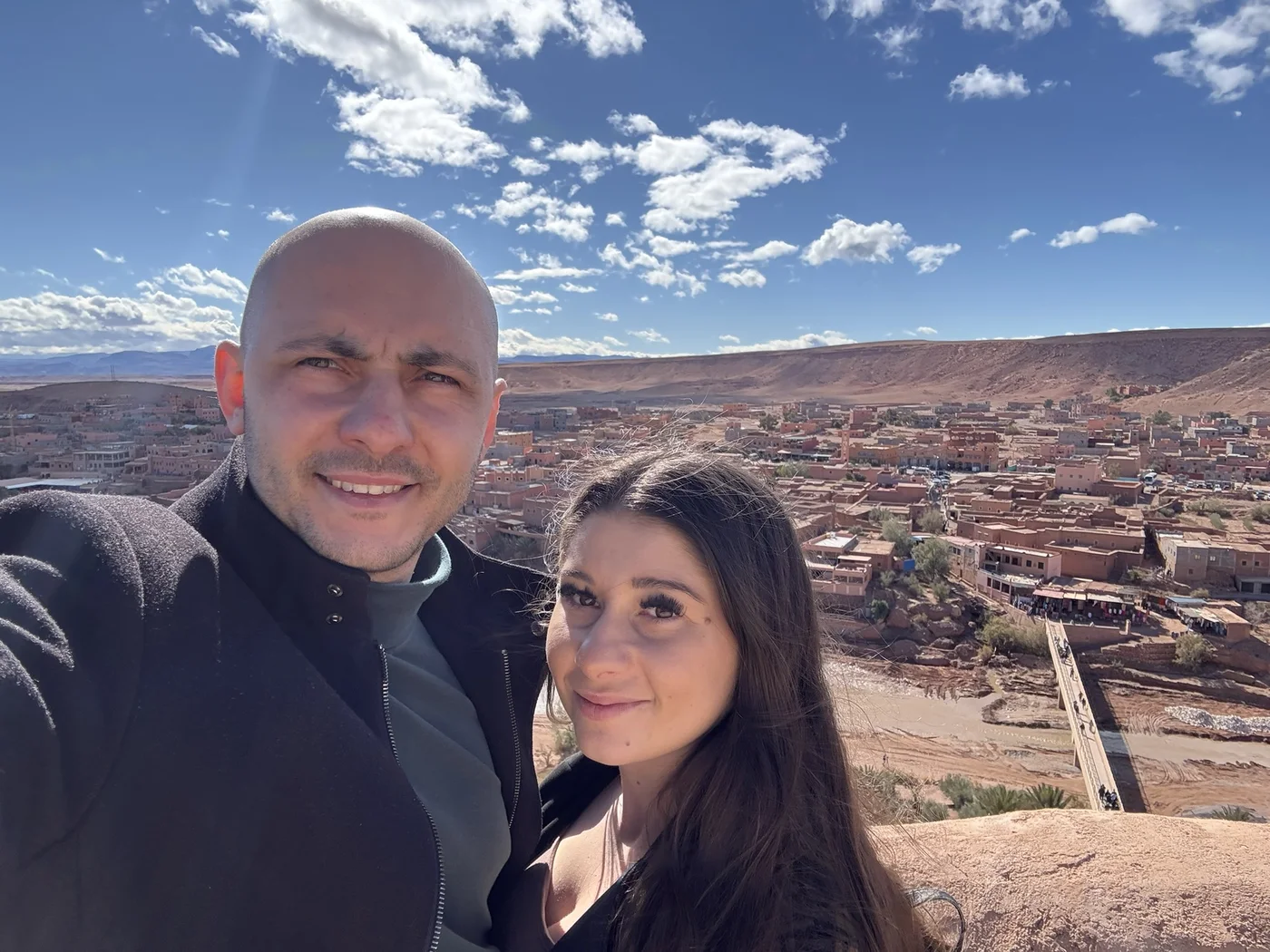
The two of us above Ait Benhaddou with the village, the hills and a bright blue sky behind.
The stop is short — a tour gives you about ninety minutes here. 13:28
Opening hoursNo gate and no published hours — it is a village.
PriceNo official entry fee exists. Individual houses and the granary climb charge small informal amounts in cash.
Advance bookingNone. Guides are optional, not compulsory — arrange one through your accommodation or tour rather than at the entrance.
Free entryThe ksar itself, in effect.
Best timeEarly morning or late afternoon, when the earth walls go orange. A tour puts you there at midday, which is the harshest light of the day — ours was at 13:28.
Allow90 minutes for the climb to the granary and back.
We wentFree entryOfficial source — UNESCO World Heritage listing
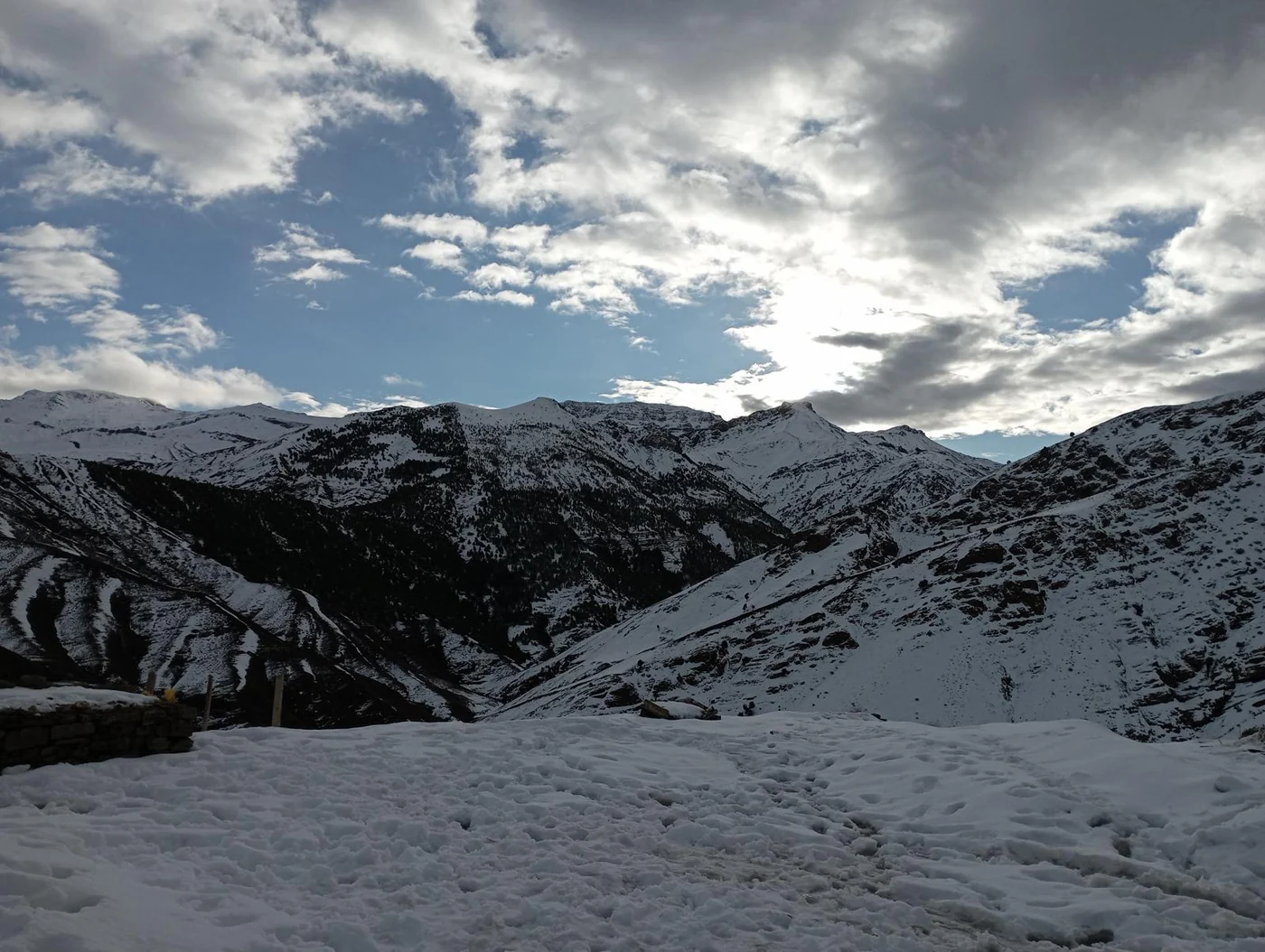
Snow lying on the dark ridges of the High Atlas under heavy cloud, seen from the Tizi n'Tichka pass road.

What You Actually See on the Way: Snow, Gorges and a Carpet Loom

The drive is not the price you pay for the dunes. It is half the trip. People book this tour for one night in Erg Chebbi and then discover that the two days of road either side cross more landscape than most countries contain. Nobody tells you that in advance, so we are telling you here.

Snow in the morning, shirtsleeves by lunch

Day one climbs out of Marrakech and over the Tizi n'Tichka, the pass through the High Atlas. It was snowing when we went over the top. Dark ridges, white ground, cloud sitting on the road. A few hours later, down the far side, it was around 25 °C and we were standing in the sun at Aït Benhaddou with our coats in the car.

That swing is the single most useful thing to know before you pack. One day on this road covers roughly twenty degrees. You want layers you can take off in the vehicle, not a single warm coat and nothing underneath — and the same again in reverse at the camp, where the desert night drops back to about freezing.

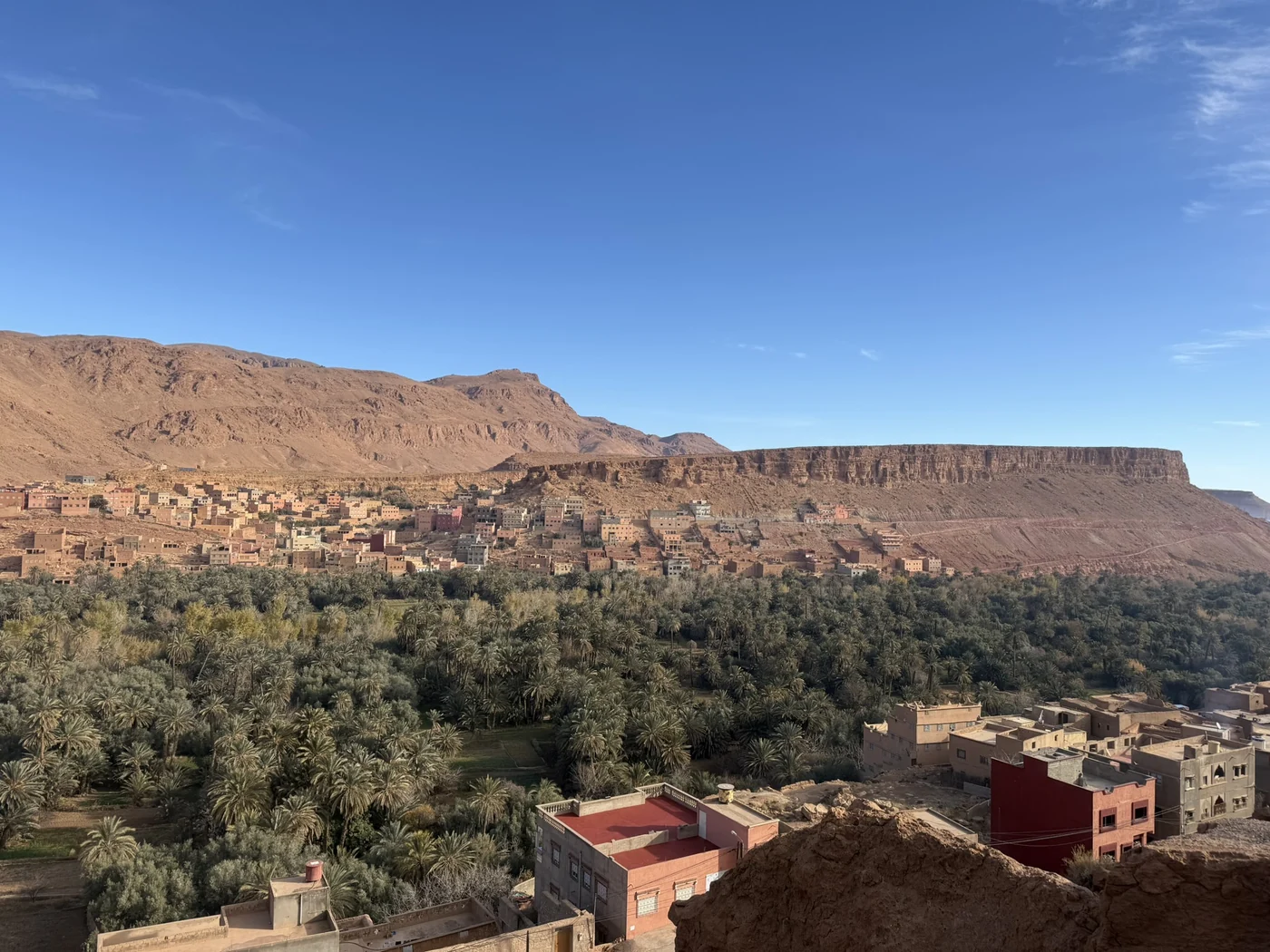
A deep green palm oasis filling a valley floor below a flat-topped red mesa, with a mud-brick town along its edge.
Green the whole width of the valley floor, with desert on both rims. 29 Dec · 10:36
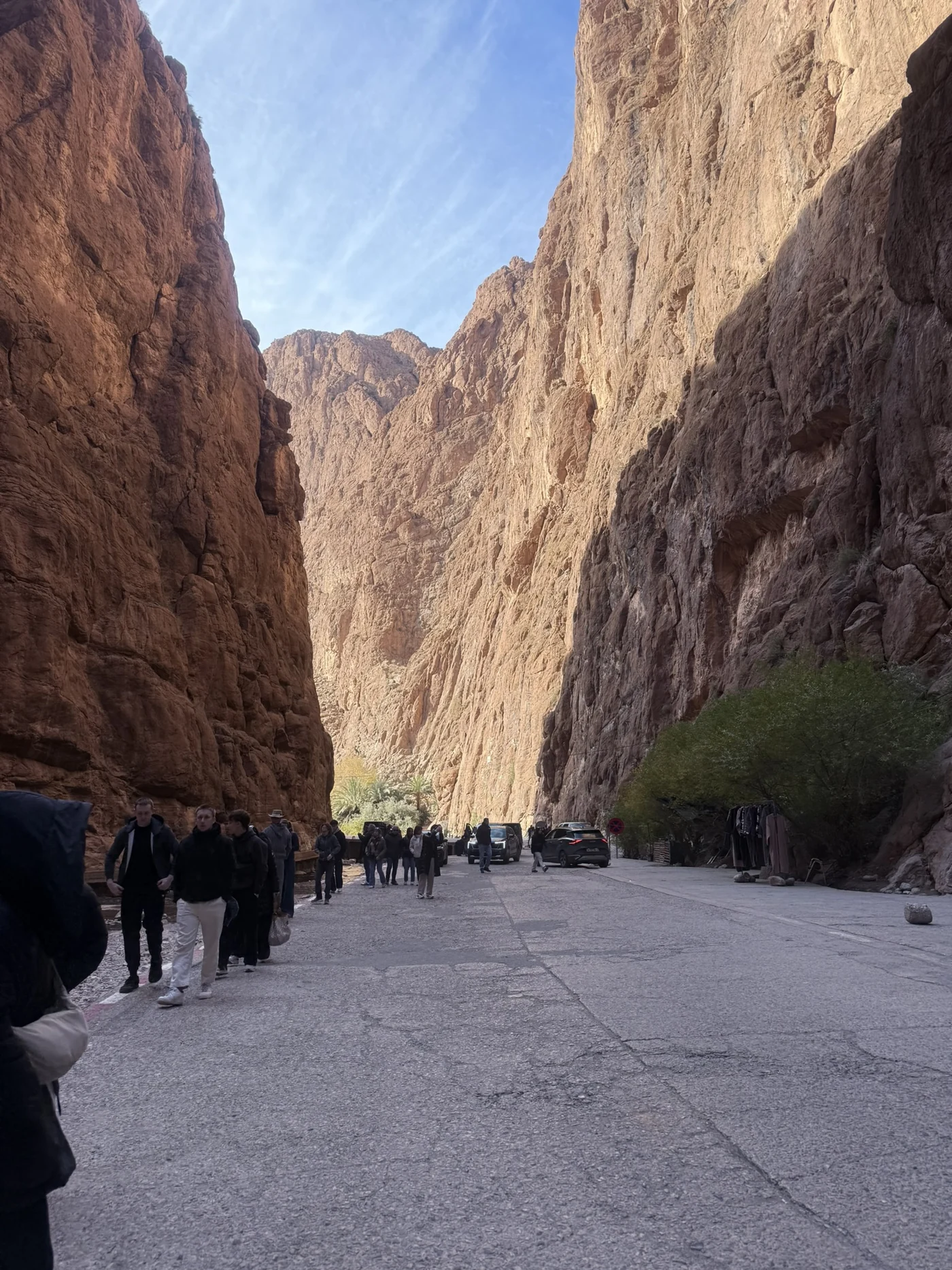
The Todra Gorge: a narrow road running between sheer orange limestone walls hundreds of metres high, with people walking along it.
The gorge narrows to a slot with a road through the bottom of it. 29 Dec · 10:56

Valleys, gorges and ground that grows things

Between the mountains and the sand, day two runs through a string of places worth lifting your head for. The Valley of the Roses around El Kelaâ M'Gouna, where the damask roses that go into Moroccan rosewater are grown — in late December there is nothing in flower, but the valley and the terraces are the point. The oasis valleys, where a river turns a strip of desert into dense palm groves and the fields are green to the inch, with bare red rock standing over them on both sides. And a canyon: the Todra Gorge, where the walls close to a few tens of metres apart and rise a few hundred straight up, with a road and a stream threaded through the bottom.

None of these is a stop you would have chosen from a brochure. All of them are better than the brochure.

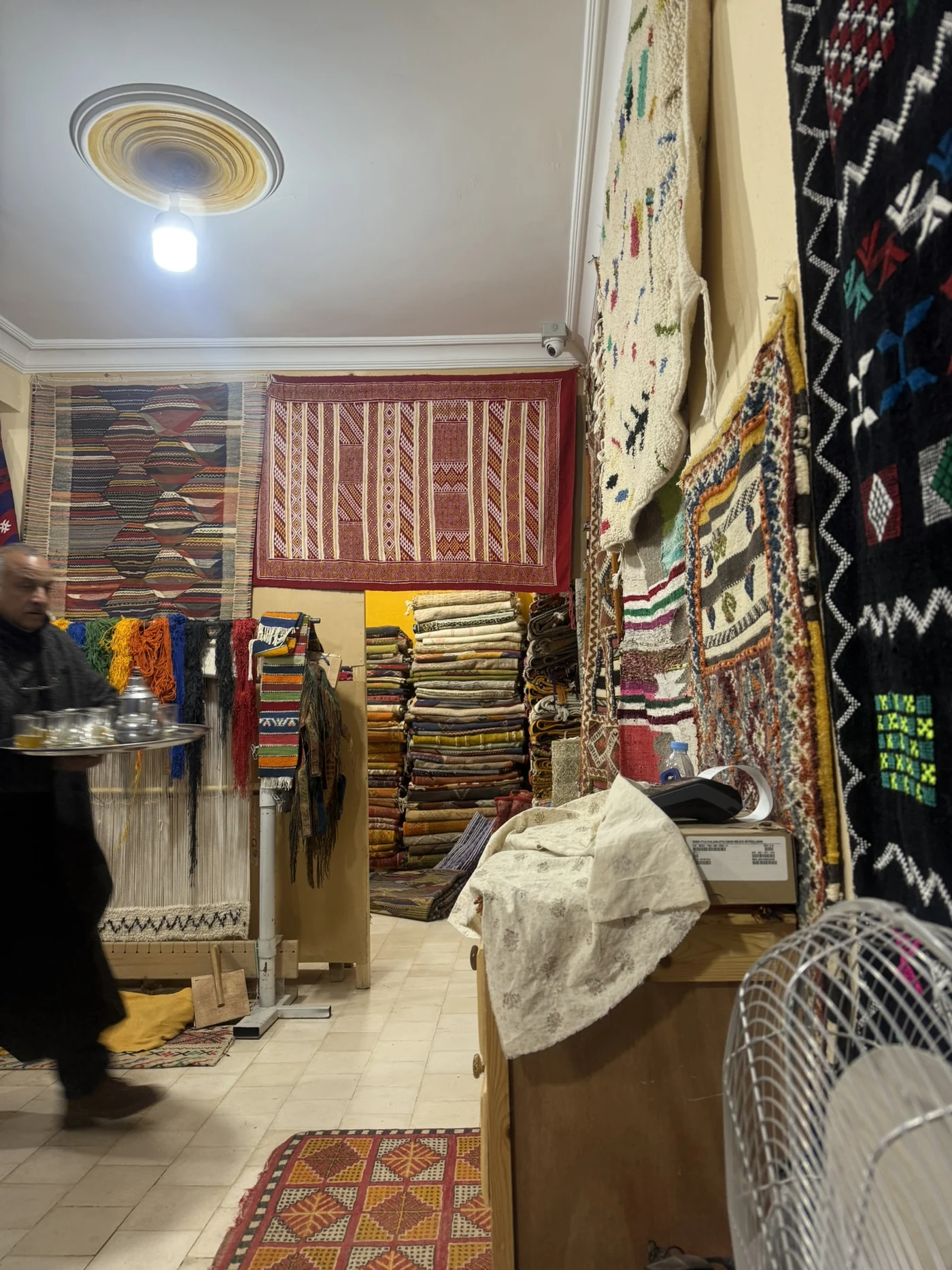
The inside of a Berber carpet workshop: rugs hanging on the walls and stacked in bolts along the shelves, with a man carrying a tea tray across the tiled floor.
The carpet stop — woven by hand in the village, sold in the room next door. 29 Dec · 09:52

The carpet workshop, and how to handle it

Somewhere on day two you will be taken to a co-operative where local women weave carpets by hand. You are shown the loom, the wool, the dyes and the difference between the knots, and then you are shown into a room where the carpets are sold, and mint tea arrives.

This is a sales stop and also a genuinely interesting one — both things are true. The weaving is real work done by hand and watching it is worth the half hour. Go in knowing that the second half is a negotiation, and that nobody minds if you drink the tea, say thank you and buy nothing. If you do want a carpet, haggle; the first number is not the number.

What it crossesThe High Atlas at Tizi n'Tichka, Aït Benhaddou, the Dadès and Valley of the Roses, the Todra Gorge, and the Draa and Ziz palm oases.
Temperature swingSnow at the pass, about 25 °C the same afternoon, and back to roughly 0 °C overnight in the dunes. Dress in layers.
Time in the vehicleLong. Day two is the biggest drive of the three, broken by these stops.
Shopping stopsExpect at least one — usually a carpet co-operative, sometimes an argan oil one as well. Not compulsory to buy.
Best seatThe right-hand side going out of Marrakech, for the pass and the gorges.
We wentOur own route, 28–30 December 2025.
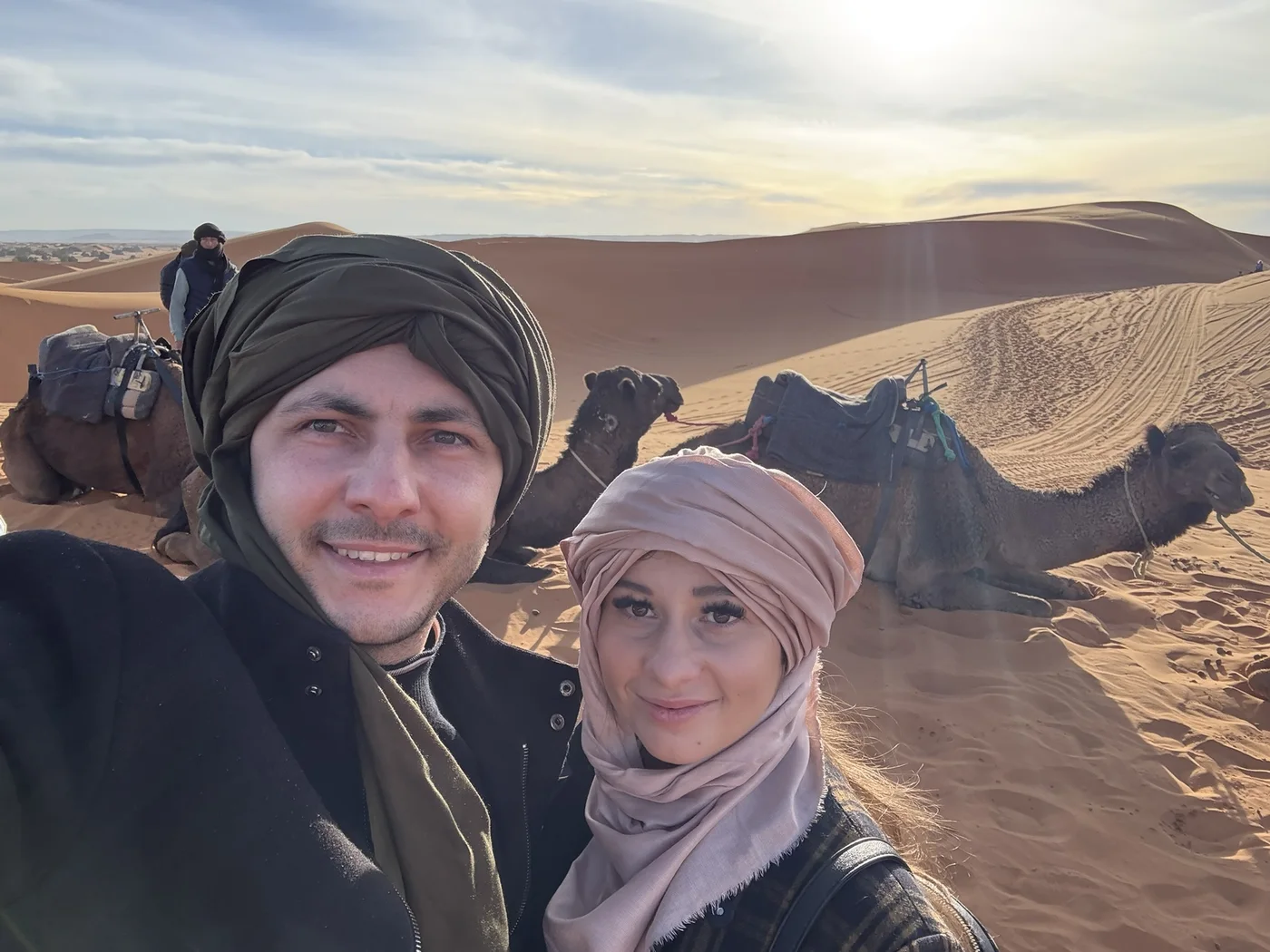
The two of us in desert turbans with couched camels on the dune behind, the low sun catching the sand at Erg Chebbi.

The Camel Trek into Erg Chebbi: What Actually Happens

You are dropped at the edge of the sand in the late afternoon, handed a turban, and put one to a camel. The trek to the camp is short — this is not an expedition — and it is timed so that you are up on the dunes as the light goes. Our photographs from the first evening are at 17:05, with the sun already low and the camels couched on the slope.

We went
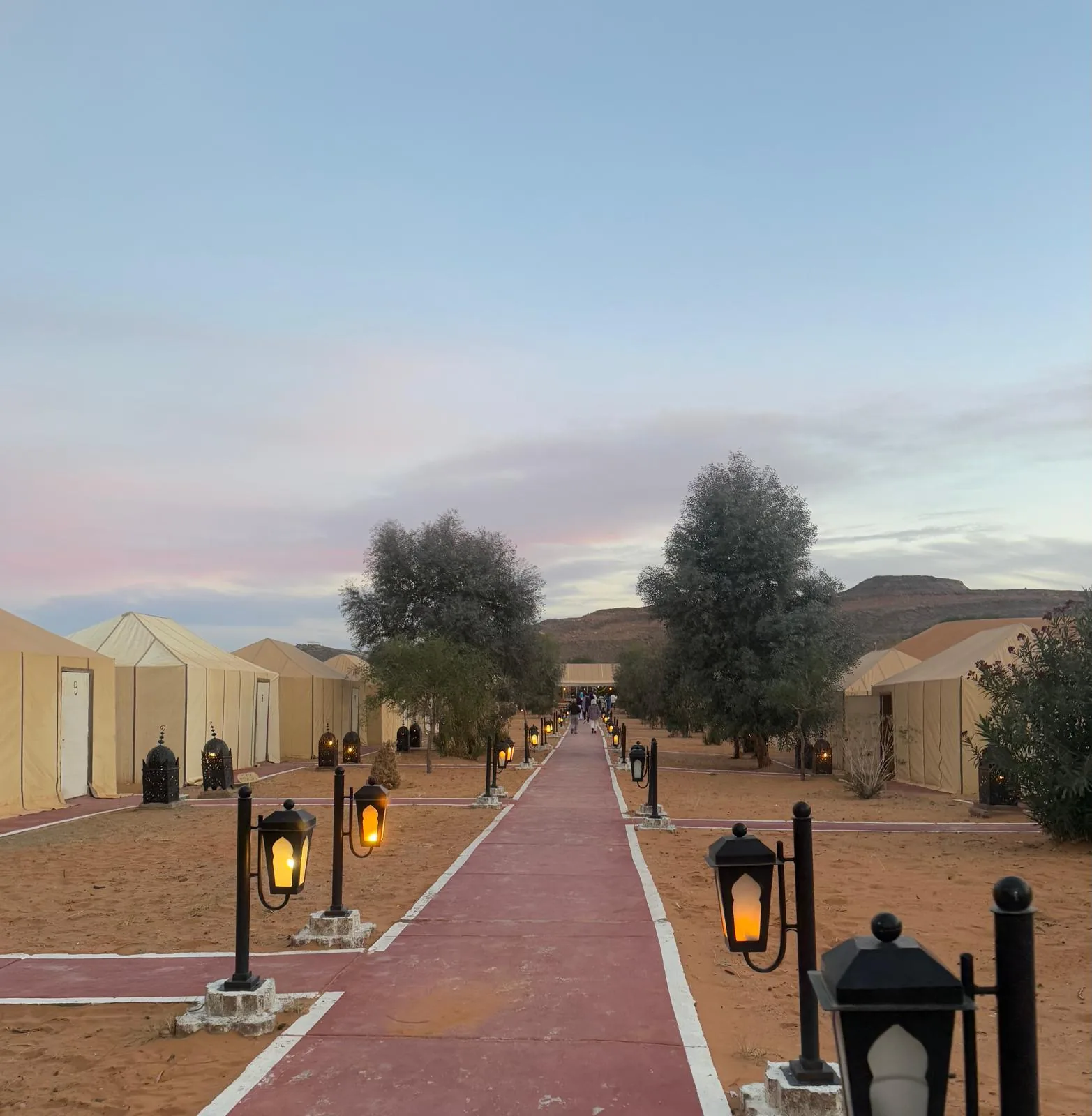
A red-paved avenue lined with lit lanterns running between rows of canvas tents at a desert camp, with tamarisk trees and a rocky mesa behind, at dusk.

The Desert Camp: What “A Night in the Sahara” Actually Means

Here is the thing nobody tells you, and the reason this section exists. The standard desert camp is not a bivouac in the dunes. It is a permanent, serviced site: canvas tents on fixed foundations with numbered doors and named suites, laid out along paved avenues with painted kerbs, lit by electric lanterns on cast posts, planted with tamarisk and oleander, and backed not by an ocean of sand but by a rocky mesa at the edge of the erg.

Whether that is good news or bad news depends entirely on what you were expecting. If you came for solitude under the stars, this is a disappointment and you should pay for an isolated private camp instead. If you are travelling with family, in winter, and you would like a door that locks, a heater, and a hot shower, it is exactly right — and it is why the three-day crossing is doable with children at all.

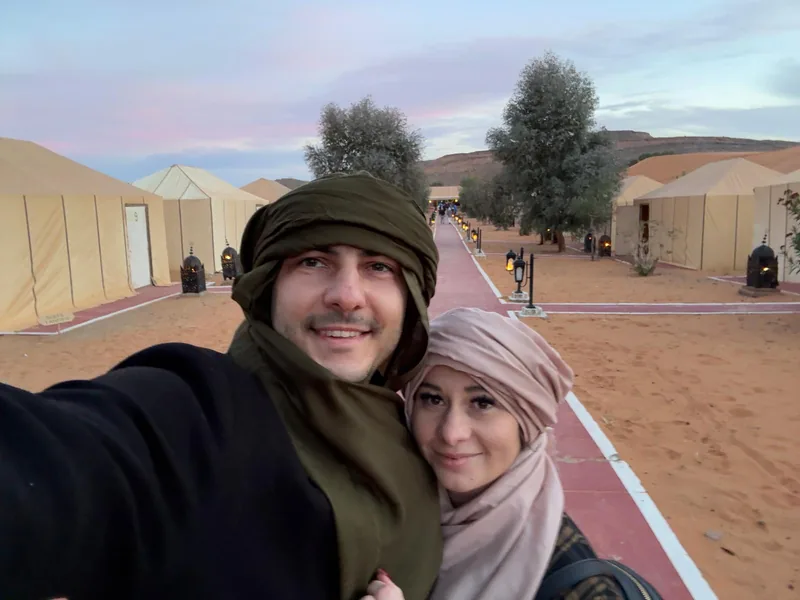
The two of us in desert turbans on the camp walkway at dusk, rows of tents either side.
Turbans on. The light goes before six and the temperature goes with it — around freezing by the small hours.
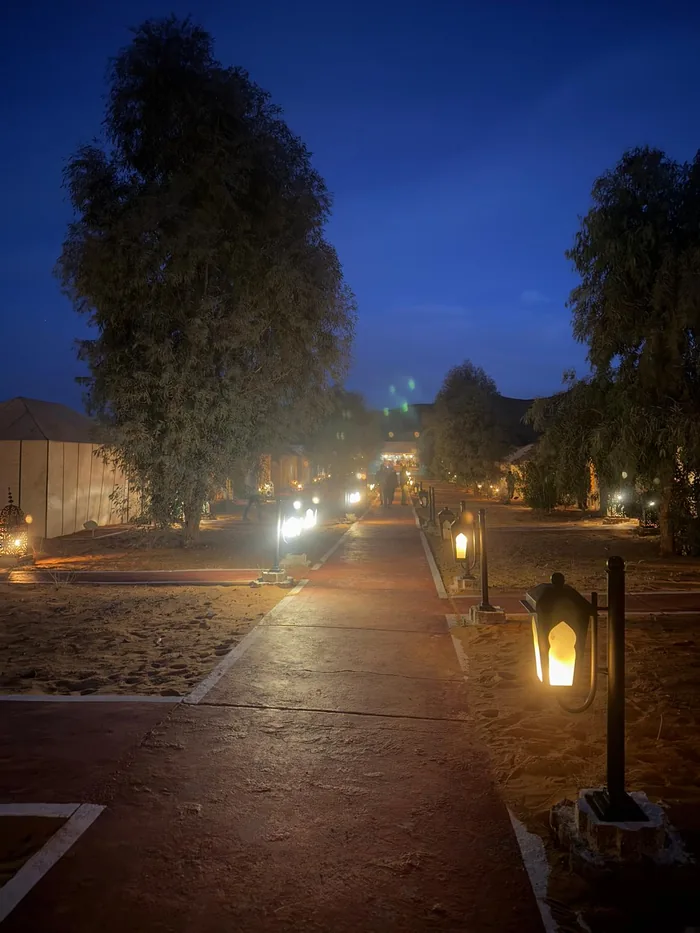
The lantern-lit avenue of the camp after dark, tents either side, people walking towards the lit dining area at the end.
The same avenue an hour later. Everything is lit; nothing is dark the way you expect the desert to be.

The evening

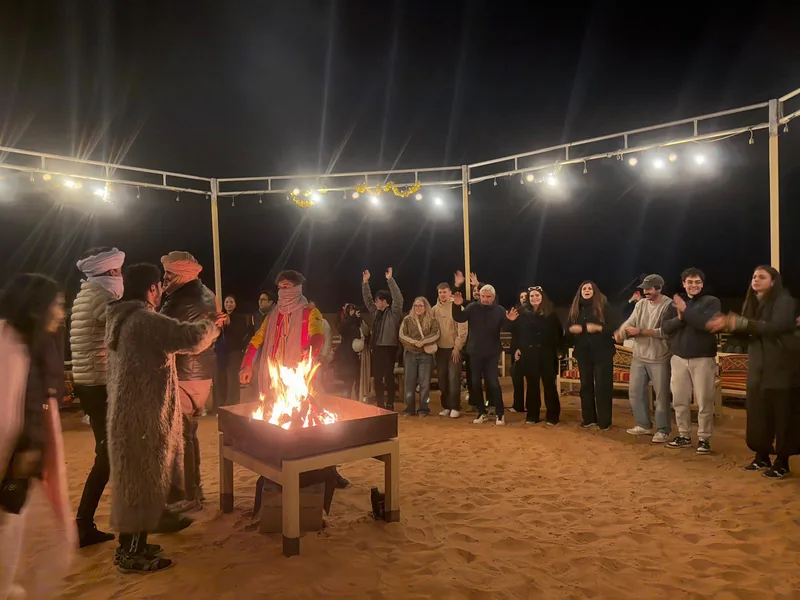
Dinner is served in a covered hall at the end of the avenue, and afterwards everyone moves outside to a sand courtyard with a steel frame strung with festoon lights, a square iron fire pit raised off the ground, and benches with kilim cushions round the edge. Then the staff change into jellabas and turbans, bring out their own instruments, and play traditional Moroccan music round the fire — live, not a speaker — with traditional dancing to go with it, and they pull guests in to join. It runs about an hour. It is the part of the night everyone films.

A raised iron fire pit burning in the sand, with a guide in a turban leading dancing and a circle of guests clapping under strings of lights.
Live, played and danced by the staff, every night. They are visibly better at it than anyone else present.
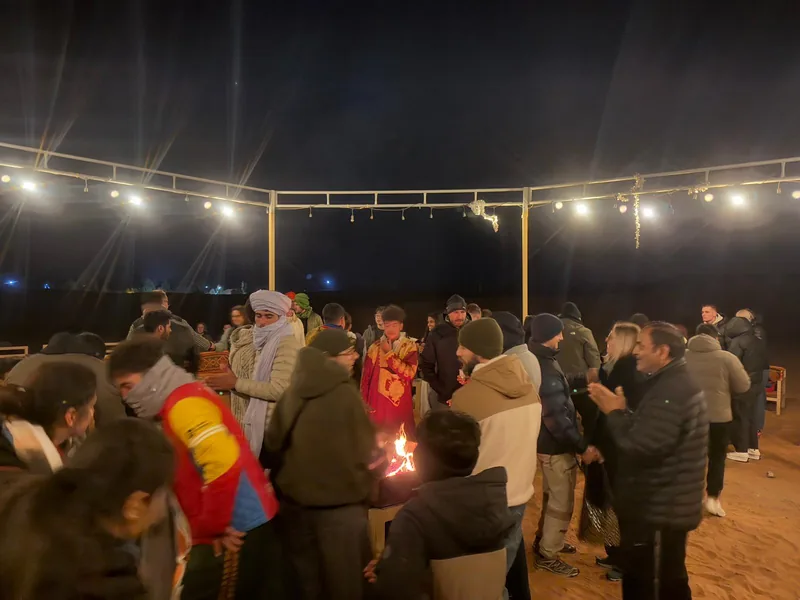
Dozens of guests in winter coats and hats standing around the fire pit under festoon lights at the desert camp.
Count the coats. This is the twenty-ninth of December in the Sahara.

It is not a private evening. Several tours converge on the same camp, so there are dozens of people round that fire from half a dozen minibuses — which is worth knowing if you had imagined a handful of travellers and a guitar. The upside is that it is genuinely good-natured, and the tour groups mix.

How cold it actually gets — and why it matters less than you think

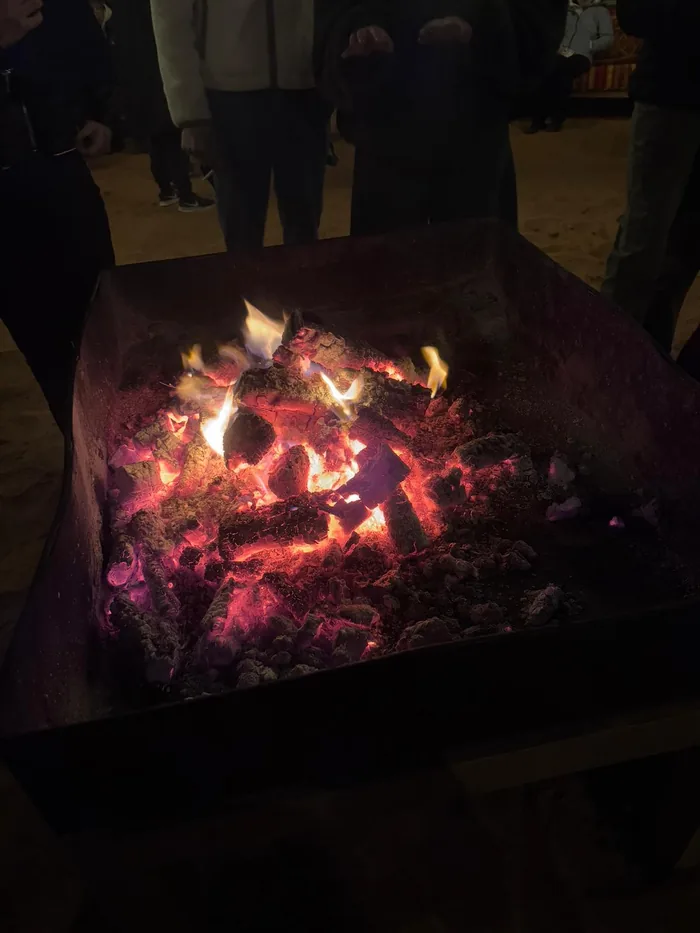
A close view of the fire pit burned down to glowing embers, with guests' legs standing around it in the dark.
Nobody leaves the fire until it is embers.

Every photograph we have from that evening shows the same thing: down jackets, woolly hats, scarves wrapped twice, and hands held over the fire. Nobody is dressed for a warm night. The sun goes before six in late December and the temperature follows it straight down — it was around freezing overnight. The Sahara in winter is a cold desert, and the strength of the sun on the dunes at four in the afternoon tells you nothing whatsoever about nine in the evening.

But here is the part that genuinely surprised us, and it is the single most useful thing on this page: the tent was heated. There is an air-conditioning unit that runs as a heater, and the tent has its own bathroom with hot water. Not a shared block, not a bucket. Zero degrees outside, a warm room and a hot shower inside.

And out at the fire it was fine. Not pleasant-in-a-shirt fine, but entirely bearable in a coat — close enough to the fire pit, with a hundred people round it, that nobody cut the evening short. The cold is a packing problem, not an endurance problem. That is worth saying because most accounts of this night are written as a feat, and it isn't one.

What to actually pack for this one night. An insulated jacket, a hat and gloves — all of which you will have been carrying uselessly through Marrakech. Put them in the small bag you take to the camp, not the one that stays in the minibus, because you will want them from the moment you get off the camel. You do not need a sleeping bag, thermals, or anything you would buy for a mountain. You need one warm coat for about four hours outdoors.

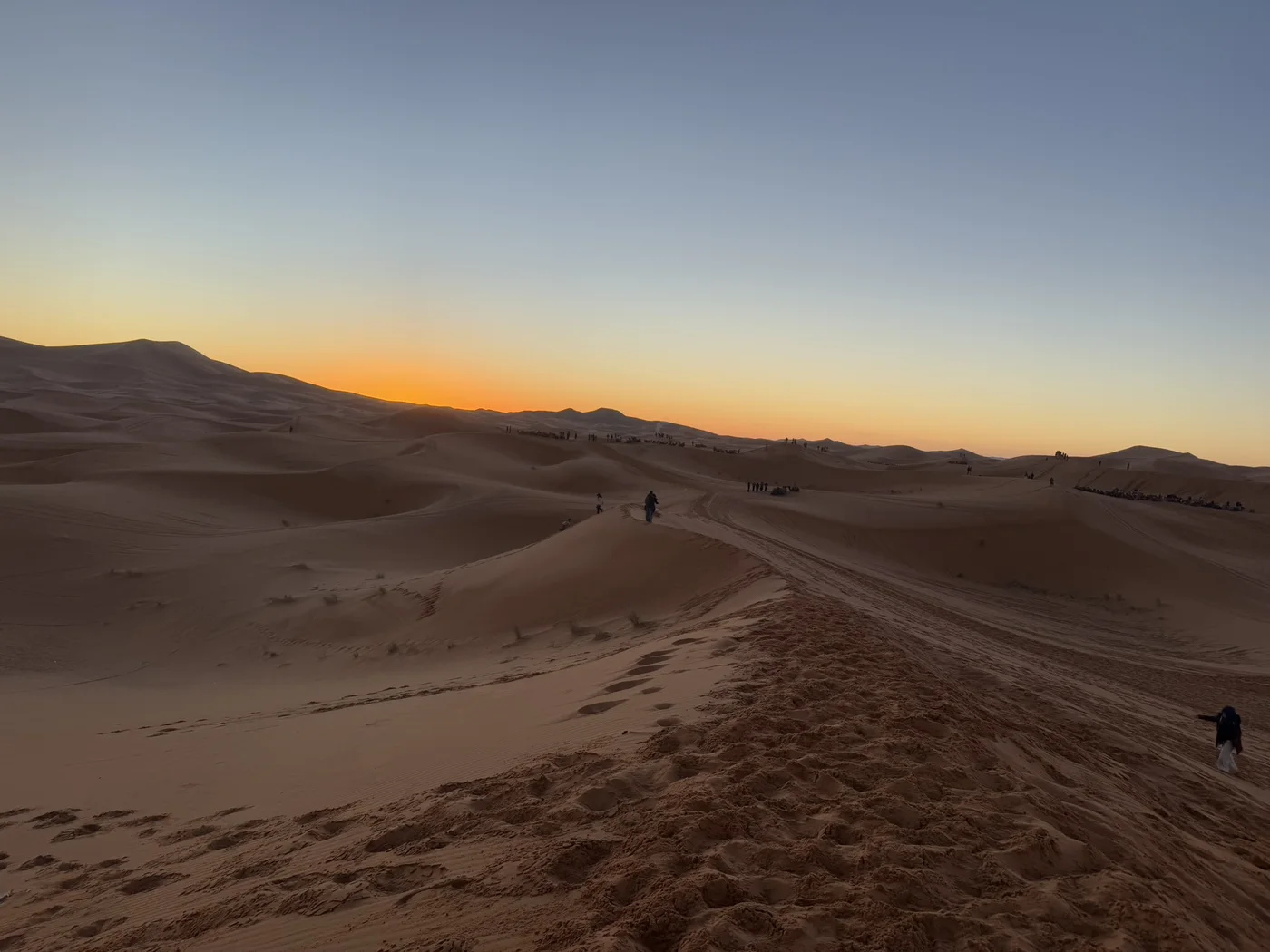
The dunes of Erg Chebbi before sunrise, an orange band along the horizon and a line of footprints running down the sand.

Sunrise at Erg Chebbi: The Twenty Minutes That Pay for the Drive

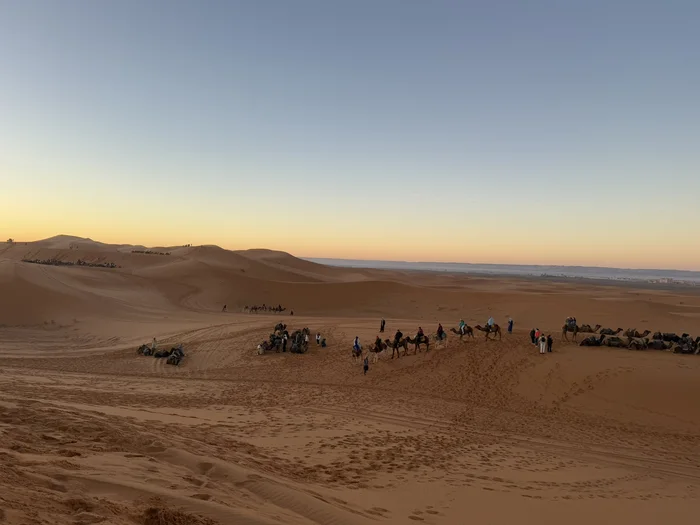
You are woken before it is light and you climb a dune. Nothing about that is negotiable and nobody minds. Reading it off our own photographs, in the last days of December: at 08:14 there was an orange band along the horizon and no sun; by 08:17 the camp below was loading; and by 08:31 the caravan was strung out along the ridge in full light and warm on the sand.

The camel caravan and camp gathered in a hollow between dunes at first light, seen from a dune crest above.
The camp from above, waiting to load. 08:17
A line of camels and riders strung out across the sand at Erg Chebbi in the early morning light.
Twelve minutes after the sun cleared the ridge. 08:31

Climb further than the group does. Everyone stops on the first crest above the camp. The footprints in our photographs are the tell — the shots worth keeping are from a ridge or two beyond, where nobody is standing in them.

Opening hoursNot applicable — you are already there.
PriceIncluded in every desert tour.
Advance bookingThrough the tour. Camps sell out over Christmas and New Year.
Best timeLate December: horizon glow from about 08:10, sun over the crest around 08:18, warm side-light on the dunes until roughly 09:00. Earlier in summer.
AllowBe on the dune fifteen minutes before, and stay twenty minutes after.
We wentBook ahead

Quick answers

Sahara Desert Tour FAQ

How much does a 3-day Marrakech to Fes desert tour cost?

We paid €395.86 for two — €197.93 each — booked through GetYourGuide for a shared group departure on 28 December 2025, which is peak holiday week. Advertised prices run from roughly 95 euros per person for a group minibus outside the holidays to 200 and up for a private car. Transport, one hotel night, one camp night, two breakfasts, two dinners and both camel treks are normally included.

What is not included in a Sahara tour?

Every lunch and all drinks, your hotel in Fes at the end, quad biking at about fifty euros a quad, and optional local guides. Budget ten to thirteen euros a meal on top of the tour price.

Is there an entry fee for Ait Benhaddou?

No state entry fee exists — the ksar is an inhabited village and it is not on Morocco's official monument ticketing portal. Individual kasbah houses and the climb to the granary charge small informal amounts in cash.

What time is sunrise in the Sahara in December?

At Erg Chebbi in the last days of December the horizon starts to glow around 08:10 and the sun breaks the dune crest at about 08:18. By 08:30 it is full daylight on the sand. That is a far kinder hour than the summer equivalent.

Is the Sahara cold at night in winter?

Yes — it was around freezing overnight at Erg Chebbi at the end of December, and it catches people out because the afternoon is warm enough for a shirt. But it is manageable: around the fire a coat and a hat were enough, and the tent itself was heated. One warm jacket covers the whole night.

Do the desert camp tents have heating and a bathroom?

Ours did, and this is the thing most accounts leave out. The tent had an air-conditioning unit running as a heater and its own bathroom with hot water — not a shared block. A standard camp on this route is a permanent serviced site with paved paths and electric light, not a bivouac, so you are nearer a hotel room than a tent in the sand. If you want the opposite of that, book an isolated private camp deliberately.

Should you do the desert as a round trip from Marrakech?

Only if you have to come back to Marrakech. The one-way Marrakech to Fes version covers the same ground and leaves you at the other end of the country with Fes and the north in front of you, which is a better shape for a week.

A little more adventure in your inbox.

The newsletter is being set up. Until it opens, write to us and we'll add you to the first send — and we'll answer any question about a trip while we're at it.

Email us

No spam, one click to unsubscribe once it starts. We never share your address — see the privacy policy.